


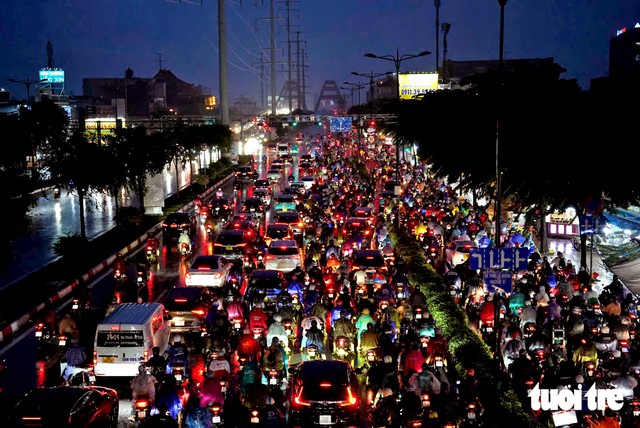
Traffic is heavily congested on a road leading to Tan Son Nhat International Airport in Ho Chi Minh City, October 7, 2026. Photo: Huu Duy / Tuoi Tre
At a press briefing on Thursday, the city’s Department of Construction said flooding occurs when rainfall exceeds the design capacity of the current drainage system.
For example, during a downpour on October 1, Truong Son Street was submerged by 10-15 centimeters of water.
The system was designed to handle 85.3 millimeters of rain over three hours, but the October 1 downpour delivered 155.2 millimeters in just over three hours.


To mitigate immediate impacts, the Ho Chi Minh City Urban Drainage Company deployed crews to clear debris from drains, open manholes to increase water flow, and set up barriers at flooded sites.
Traffic police guided vehicles away from submerged areas to ease congestion.
Regarding long-term solutions, two projects are underway to improve drainage around Tan Son Nhat Airport.
The A41 Canal renovation project, managed by Tan Son Nhat Ward’s project management board, is slated for completion in 2027.
The Hy Vong Canal environmental improvement project, overseen by the city’s urban infrastructure management board, is expected to finish in 2029.
Recent downpours have shown how quickly congestion can spread.
During the evening rush hours, flooding near the airport caused traffic jams stretching several kilometers onto Pham Van Dong Boulevard and Cong Hoa Street.








Max: 1500 characters
There are no comments yet. Be the first to comment.