


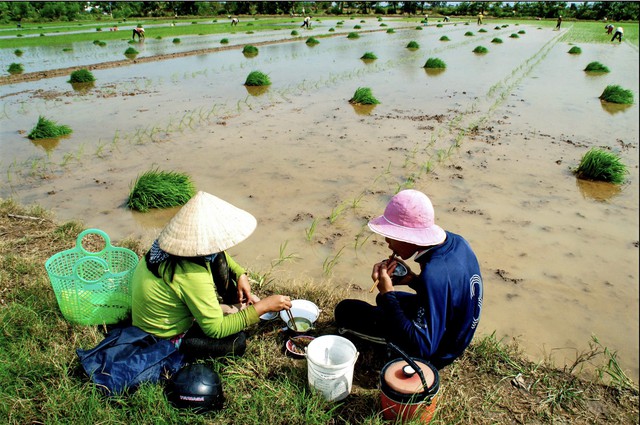
Farmers in Ca Mau Province, Vietnam's Mekong Delta region, enjoy a simple field meal, food shared with field workers and eaten right in the rice fields under the sun. Photo: Phan Thanh Cuong
A distinctive tradition among farmers in Vietnam's Mekong Delta is to provide meals for people hired to work in the fields, whether they are day laborers or workers hired for specific tasks.
Rather than returning home for lunch, everyone often eats together right there in the rice fields, under the open sky, turning a simple midday meal into part of the farming tradition.
Out in the fields, a meal is meant to be shared
'Com cay,' or field meal, refers to simple field meals prepared at home and carried out to the rice fields for people working there.
The food was often eaten quickly in the middle of the fields, under the open sky, before farmers returned to planting or other work.
The tradition grew out of the way rice was once grown in Vietnam’s Mekong Delta, one of the country’s most important rice-producing regions.
Farmers would first grow rice seedlings in one area. Once the seedlings were ready, they would pull them from the ground and transplant them by hand into another field.
During planting season, farmers often hired workers to help with the labor-intensive process.
The person who provided the work would also provide their meals, giving rise to the name 'field meal,' literally referring to the meals brought out to those doing the rice transplanting.
Le Duc Chi, a resident of Ca Mau Province, remembers the tradition from his childhood.
His uncle once owned more than 100 units of farmland, and nearby Khmer women would come to work as rice planters.
They were paid in advance and returned during planting season to work in the fields.
Chi was often the one responsible for bringing their meals.
“I used to bring food out to the field for the rice planters. That was what we called 'com cay,’” Chi said.
The work could begin long before sunrise.
When there was enough moonlight, workers sometimes started at 2:00 or 3:00 am, pulling seedlings from the ground and planting them row by row.
By the time the sun rose and the heat became intense, they could already have finished their assigned work.
If heavy rain or extreme heat stopped them during the day, they would take a break and make up the work later.
Preparing the meals was a job in itself.
Chi’s aunt would wake before dawn to cook for dozens of workers. When the sun came up, she would load the food onto a small boat, and Chi would row it out through the fields.
For families without a boat, there were other ways to get lunch to the workers.
Some carried the meal in baskets or large bags, while others built simple shoulder poles to carry the food, bowls and chopsticks out to the fields.
The result was a distinctly Mekong Delta scene: a home-cooked meal arriving by boat in the middle of a rice field, with farmers sitting down together under the sun before returning to work.
What might look unusual to an outsider was once an ordinary part of life for generations of rice farmers.
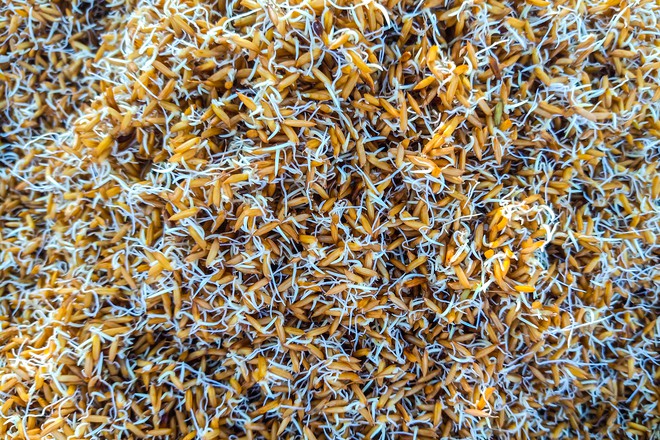
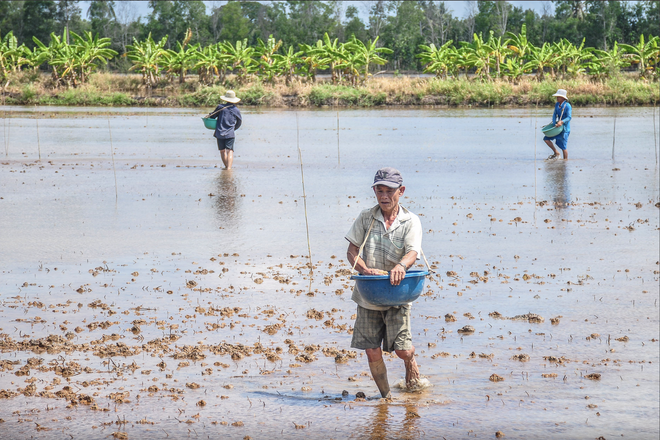
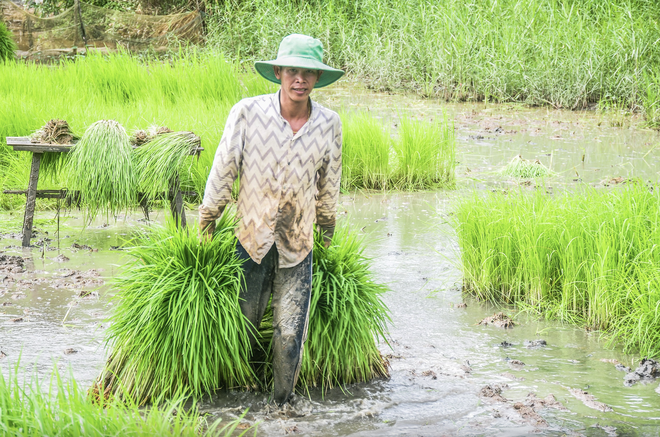
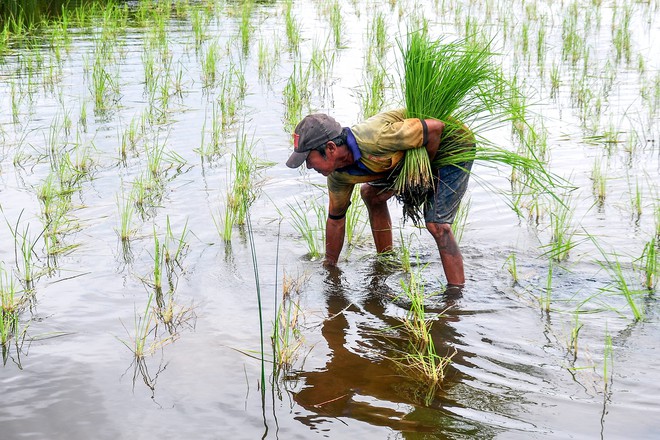
Some of the rice-growing steps once practiced by farmers in southern Vietnam, from soaking seeds to sprout, to sowing, pulling up seedlings and transplanting them. Photo: Ngo Hoang Vu
A humble feast by the rice fields
There was nothing elaborate about a 'com cay' meal.
Farmers ate whatever was available, often taking a short break after eating before returning to work. If the day’s work was finished early, they could head home early too.
There was no dining table. Meals were set down wherever the work happened, on the edge of a rice field, under a tree or beside a pond.
Banana leaves, sacks or the lids of containers could become makeshift tables. Sometimes, nothing was used at all. If there was food to eat, that was enough.
In some fields, the narrow strips of land between rice paddies were too small to sit on.
When the fields were deep and waterlogged, workers would stand in the water while eating, with the food placed on the bank.
“When I brought the food out to the field, everyone would call to one another to wash their hands and come eat,” Le Duc Chi recalled.
A typical meal consisted of just a few dishes, depending on what was available that day.
There was little expectation that the person providing the meal had to serve anything fancy.
Salty dishes were common because they helped replenish salt lost through heavy sweating during physical work.
The food could include fermented fish cooked with eggs, braised fish, dried fish, salty fried shrimp, boiled vegetables, eggs with preserved radish and a simple mixed-vegetable soup.
And sometimes, the fields themselves supplied the main dish.
If workers caught a snakehead fish while pulling up rice seedlings, they could roast it over rice straw or dried grass and eat it right away.
Others might pick water spinach, water mimosa, water lily stems or bitter greens growing nearby, wash them and dip them straight into fish sauce.
These simple meals carried the smells of the countryside with them, muddy water, fresh rice seedlings and ripening rice mixing with the scent of freshly cooked food.
For those eating, the combination could make an ordinary bowl of rice taste unforgettable.
On some days, field meal was even simpler: sticky rice cooked with beans, topped with sesame salt or crushed peanut salt.
There was no elaborate preparation, no proper table and no special occasion, just food, the people who worked the fields and a meal shared in the middle of the countryside.
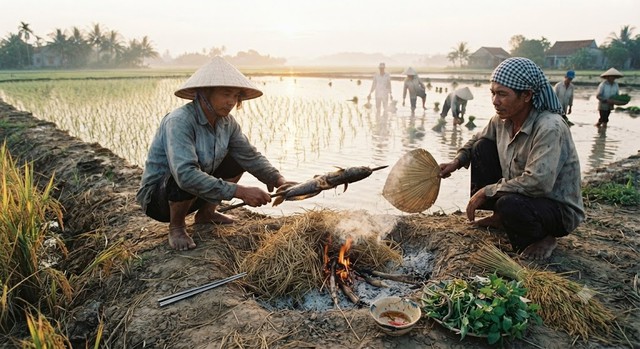
Farmers roast a freshly caught fish in the rice fields to add to their simple field meal. Photo: AI-generated
Why simple can taste so good?
The meal was simple, yet everyone seemed to relish it.
The pleasure did not end when the meal was over. Even years later, those who once shared these field meals still remember them as delicious, although, as one person put it, “I don’t even know why they tasted so good.”
Han Ai Tien, former editor-in-chief of Bac Lieu newspaper, offered an explanation.
“Farmers had to wake up in the middle of the night or early in the morning and travel to the fields, sometimes going a long way. Then they would spend hours doing hard physical work," he said.
“By the time the meal arrived, they were extremely hungry. And the meal itself was a joyful occasion. Sometimes 10 or 20 people would sit down together, talking and laughing," he explained.
"Eating out in the fields also created a different atmosphere from eating at home. There was a sense of community, neighbors working and eating together, looking out over what they had accomplished in the fields. Perhaps that is where the food tasted so good," he said.
Today, as workers from the Mekong Delta increasingly move to cities for jobs, the large gatherings once associated with these field meals have become less common.
Families now tend to arrange their own work, while those who hire workers often pay them extra to cover their meals instead of preparing food for them.
The arrangement is more convenient for workers, who can bring whatever food they prefer. It also saves employers the time and effort of preparing meals for a group.
People in the Mekong Delta still bring food with them when they work in their fields and gardens, but the meals are usually smaller and more informal.
“These field meals are a reminder of a land that was both fertile and demanding, where people learned to rely on one another and find joy even in hardship,” Han said.
“They reflect the beauty of hard work and the open-hearted spirit of people in southern Vietnam. That spirit remains woven into everyday life in the river delta," he said.








Max: 1500 characters
There are no comments yet. Be the first to comment.