


Vietnamese and international experts shared experience and solutions for smart urban development at the Thursday workshop, with discussions focusing on affordable housing, transit-oriented development (TOD), green infrastructure, and improving residents’ quality of life.
Singapore experience in affordable housing
Architect Bernard Low Boon Yong, general director of Singapore-based Global Vireon Studio Co., Ltd., said providing affordable homes for people with modest incomes remains a major challenge as Vietnam and Ho Chi Minh City continue to urbanize rapidly.
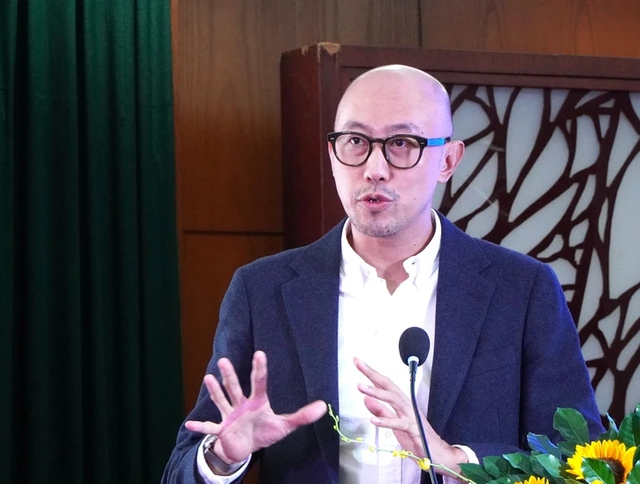
Architect Bernard Low Boon Yong, general director of Singapore-based Global Vireon Studio Co., Ltd., speaks about smart, affordable housing at the workshop. Photo: Ai Nhan / Tuoi Tre
Vietnam is expanding social housing, rental housing, and reasonably priced commercial housing, all backed by government policies in ways broadly similar to Singapore’s public housing model, Boon Yong said.
The Singaporean government has allocated about eight percent of public land to build more than 1.13 million public housing units, accommodating around 80 percent of the population, or some 3.2 million people.
About 90 percent of public housing residents own their homes.
“Singapore has adopted seven principles to ensure that public housing is not merely a place to live, but also offers smart amenities, everyday convenience, community cohesion, and a high quality of life, while keeping overall housing costs affordable,” Boon Yong stressed.
Vietnam, he suggested, should develop a comprehensive strategy for “affordable housing for the majority,” seeking to maximize housing supply at prices people can genuinely afford while maintaining construction quality and livability.
TOD as a driver of smart urban development
The workshop also highlighted TOD as another key pillar of smart city development.
Endo Yuichi, deputy general director of Toshin Development Vietnam Co., Ltd., part of Japan’s Takashimaya Group, cited the area around Nagareyama-Otakanomori Station in Japan as a successful example.
The development integrates public transport with housing, commercial facilities, parks, schools, and other public amenities.
According to Endo, the TOD model has helped increase property values and supported stable long-term growth in commercial revenue and rental income, while local authorities have benefited from higher tax revenue as the area's population and economic activity expanded.
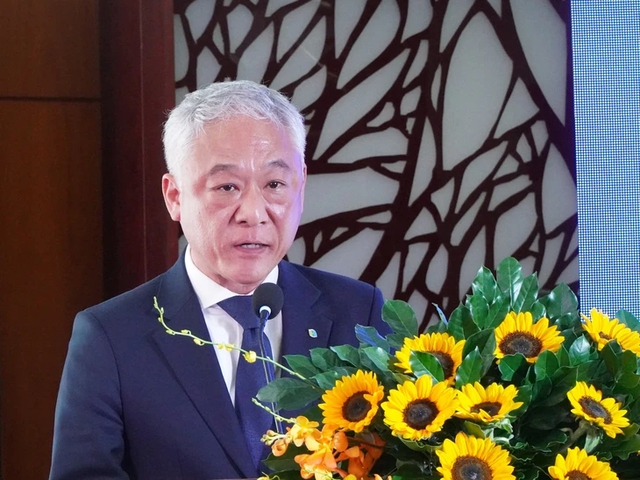
Endo Yuichi, deputy general director of Toshin Development Vietnam Co., Ltd., part of the Takashimaya Group, speaks about TOD development in Japan. Photo: Ai Nhan / Tuoi Tre
Endo said Toshin Development has developed and operates 10 commercial buildings and the plaza around Nagareyama-Otakanomori Station as part of the TOD project.
Since March 2025, all electricity used at these facilities has come from renewable sources, while used cooking oil from restaurants is collected and recycled into feedstock for aviation fuel production.
The company has also installed 24 electric vehicle charging stations and launched a Food Drive program to collect surplus food from households and distribute it to people in need, he added.
Nearly 200,000 social homes targeted by 2030
Tran Quang Lam, director of the Ho Chi Minh City Department of Construction, said the city is working to translate its smart city development plan into concrete projects, with social welfare remaining a priority.
The city aims to develop nearly 200,000 social housing units by 2030.
The department has been tasked with coordinating with relevant agencies to establish standard criteria for large-scale urban and social housing projects, with a focus on green, convenient, and modern living spaces.
The city is also accelerating urban railway development under the TOD model, aiming to enable residents to access public transport within 15 minutes.
Lam said smart city development should be integrated throughout the entire process, from planning and design to prefabricated construction, green materials, solar energy, wastewater recycling, and smart building management.
The ultimate goal, he said, is to reduce costs while improving residents’ quality of life.









Max: 1500 characters
There are no comments yet. Be the first to comment.