



Income alone is not enough to attract global talent to Ho Chi Minh City, experts say. Photo: D.P.
Experts and business executives discussed some talent-retention issues at the seminar, titled ‘Ho Chi Minh City: Attracting Elite International Talent for a New Era of Growth,' on Wednesday.
Pham Binh An, deputy head of the Ho Chi Minh City Institute for Development Studies, said international professionals are not only choosing a job, but also selecting a living environment for their families.
Retaining talent for five to 10 years is fundamentally different from sending a specialist to work on a short-term project, he noted.
The decisive factor is not income alone, but also the quality of life available to the expert’s family.
As such, the city should develop an integrated urban model in which international experts can access housing, international schools, high-quality hospitals, cultural spaces and services for older family members within a well-connected environment.
Echoing the view, a representative from the Chinese Business Association in Vietnam-Ho Chi Minh City chapter, said the city needs to shift toward an ‘all-in-one’ integrated urban model if it wants to retain international specialists.
Such an urban model goes beyond providing high-end apartments.
It requires a coordinated ecosystem comprising internationally accredited schools for children, quality healthcare services, amenities for older people and safe community cultural spaces.
Solving the city’s transportation challenges is another critical link in improving the overall living experience.
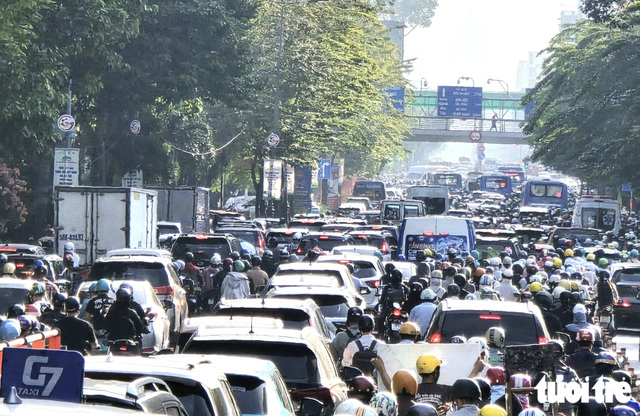
Transport infrastructure is among the bottlenecks experts have identified as an area Ho Chi Minh City needs to improve to attract global talent. Photo: Cong Trieu / Tuoi Tre
With its high density of motorbikes, Ho Chi Minh City can be difficult for foreign professionals to commute around.
In the long term, transit-oriented development, combined with an expanded urban railway network, is viewed as part of the solution.
The city aims to develop 255 kilometers of metro lines by 2030, which is expected to help accelerate infrastructure development and create faster connections between homes, workplaces and the airport.
Alongside administrative reform, experts suggested that Ho Chi Minh City develop a dedicated ‘talent city’ brand while stepping up efforts to attract overseas Vietnamese professionals, who have advantages in language, cultural understanding and international working experience.
Ultimately, the goal is not just to bring more international experts to Ho Chi Minh City, but also to create mechanisms for knowledge transfer, train the domestic workforce and strengthen the city’s long-term capacity for research, innovation and technological development.
Between January and September, the city attracted more than US$17.2 billion in newly registered foreign investment, up more than fourfold year on year and well above the full-year target.
Several strategic projects are also under development, including the Can Gio international transshipment port, an AI Factory data center and the International University Urban Area.
The influx of high-quality investment is generating strong demand for experts, engineers and managers in fields such as semiconductors, artificial intelligence, automation and research and development.








Max: 1500 characters
There are no comments yet. Be the first to comment.