


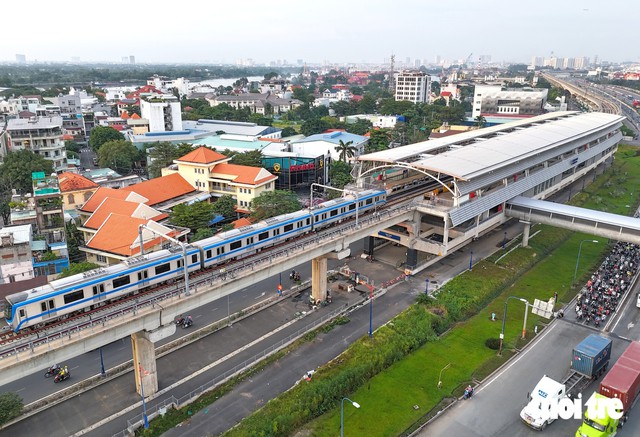
An area identified as having potential for transit-oriented development (TOD). Photo: Chau Tuan / Tuoi Tre
Metro network fosters new economic hubs
The opening of Metro Line 1 has helped improve shopping mall occupancy rates, property liquidity, and housing prices along the corridor, according to real estate services firm Cushman & Wakefield.
A company representative told Tuoi Tre (Youth) that the expansion of urban rail infrastructure is changing how investors assess development locations.
While geographical proximity to the city center once dominated investment decisions, travel time and accessibility are becoming increasingly important.
As land in central urban areas becomes increasingly scarce, distances are increasingly measured by the time it takes to reach jobs and services rather than by kilometers.
Therefore, TOD has evolved from a mere added advantage into a long-term investment strategy.
Cities such as Tokyo, Hong Kong, Singapore, and Seoul have demonstrated how metro networks can support polycentric urban development, creating multiple economic hubs while easing pressure on traditional city centers.
Ho Chi Minh City is still in the early stages of this transition, but an expanded metro network could bring benefits across several real estate segments.
While retail properties are likely to benefit first from heavy foot traffic at transit stations, the apartment segment is attracting demand from young residents seeking homes farther from the city center while maintaining convenient access to transport.
Areas such as Thao Dien, An Phu, Saigon Hi-Tech Park, and Vietnam National University-Ho Chi Minh City have significant potential to emerge as new employment, commercial, and service hubs.
In the long term, mixed-use developments combining residential, office, and retail spaces within walking distance of metro stations are expected to benefit most sustainably by maximizing land-use efficiency.
Success depends on people and jobs, not property prices
Despite these opportunities, experts warn that TOD should not be confused with simply building properties near metro stations.
Le Hoang Lan Nhu Ngoc, senior director and head of strategic consulting at Cushman & Wakefield Vietnam, said proximity to a station alone does not make a development a successful TOD project.
Without safe pedestrian access, last-mile transport connections, and integrated amenities, such projects merely capitalize on nearby infrastructure rather than fully embrace the TOD model.
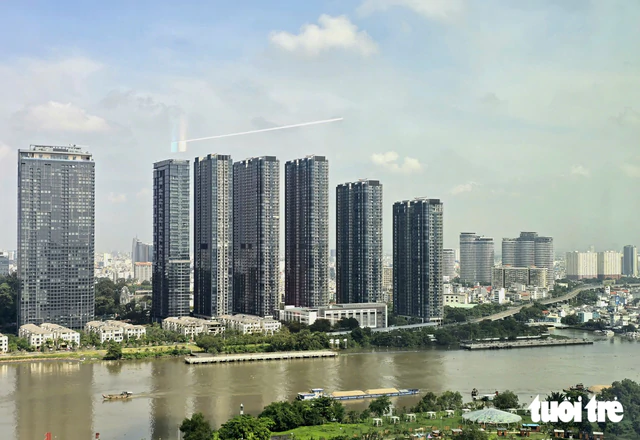
A residential neighborhood featuring apartment buildings and villas near a metro station in Ho Chi Minh City in early October 2026. Photo: Cong Trieu/ Tuoi Tre
To create genuine economic hubs instead of fueling property speculation, TOD planning must prioritize mixed land uses, walkability, appropriate development density, adequate infrastructure, and clearly defined economic functions for each area.
Transparent land development and redevelopment mechanisms are also essential.
TOD projects often involve multiple landowners, established residential communities, and complicated urban redevelopment requirements.
Assessing what determines a TOD project's success, Ngoc said that if she had to choose just one indicator to measure its performance after 10 years of operation, it would be residential and employment density.
Property prices may rise due to market expectations or limited supply, but an area can only become a genuine economic hub when people actually settle there, businesses establish offices, and workers use public transport for their daily commutes.
Ultimately, the goal of TOD is not to drive up land prices, but to improve accessibility, land-use efficiency, and productivity across the entire city.


Max: 1500 characters
There are no comments yet. Be the first to comment.