


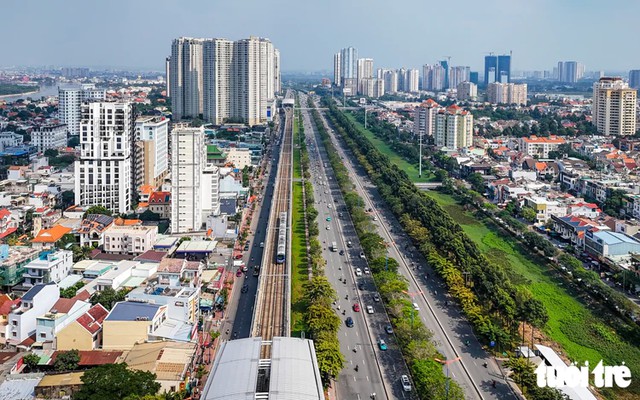
Ho Chi Minh City accelerates TOD planning around metro stations. Photo: Chau Tuan / Tuoi Tre
Investment in metro systems and TOD can generate economic value well beyond improved mobility. Better connectivity, additional development rights, land-use changes, and infrastructure upgrades can raise land values around transit stations while creating new opportunities for commercial development.
As the city requires substantial resources to expand its urban rail network, finding ways to channel part of this value back into infrastructure funding is becoming a crucial piece of the city’s TOD equation.
Funding to reinvest in metro network
The first issue is the sheer scale of funding required.
Ho Chi Minh City aims to increase public transport’s share of passenger travel to 35-40 percent by 2040 and 50-60 percent by 2060.
Under its planning orientation, the city’s urban rail network will comprise about 27 lines, requiring an estimated US$104 billion in investment, while around 21,000 hectares are earmarked for transit-oriented development (TOD) by 2035.
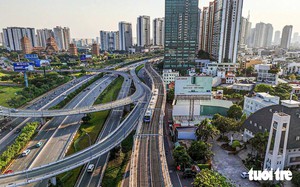
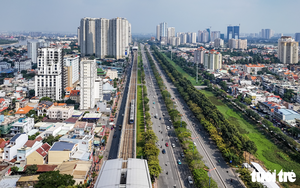
The funding needs extend well beyond the construction of tracks, stations and trains. For TOD areas to take shape, the city will also need to invest in connecting roads, technical and social infrastructure, public spaces, station access and other supporting facilities.
Dr. Nguyen Ngoc An, an expert in transport engineering and planning at the University of Bologna in Italy and a member of the expert team that drafted Ho Chi Minh City’s TOD planning and implementation technical guidelines, said the city faces a twofold task: mobilizing substantial resources for transport infrastructure while using that investment to reshape the urban structure toward more compact, higher-density, and more livable urban development around transit stations.
According to An, the financing model for large-scale infrastructure projects is also changing as access to concessional loans becomes increasingly limited and public budgets remain constrained.
As a result, part of the value created by rail investment and TOD-based land-use planning needs to be captured and reinvested in the infrastructure that helped generate it in the first place.
This approach underpins land value capture (LVC), a mechanism through which part of the economic value generated by public investment, planning decisions and development rights granted by the government is captured and reinvested in infrastructure and other public benefits.
Against this backdrop, Ho Chi Minh City is seeking feedback on five proposed charges for projects that directly benefit from urban rail infrastructure and planning within TOD areas.
These include charges on additional floor area; charges on increases in land value; revenue from the commercial use of local railway infrastructure assets and associated rights; public transport connection fees; and infrastructure improvement fees.
According to Tran Hoang Nam, head of the Real Estate program at the University of Economics and Finance (UEF) in Ho Chi Minh City, the five proposed charges are designed to capture different sources of value.
The charge on additional floor area targets the value created by adjustments to planning parameters, while the land value charge captures gains arising from changes in land use and improved connectivity to the urban rail network.
The remaining three relate respectively to the economic value generated from the use of railway assets and associated rights, the benefits of preferential access to public transport, and the sharing of part of the cost of investing in and upgrading common infrastructure among those who benefit from it.
Nam, however, stressed that each charge should reflect a specific source of value and be based on a transparent and predictable calculation.
Not all projects benefit from TOD investment to the same extent, he noted. A development directly linked to a metro station, for instance, may see greater gains than one that benefits indirectly from surrounding infrastructure or public spaces. The city should also factor in investments that developers have already made in internal roads, station access and shared infrastructure when determining their financial obligations.
“The mechanism can only work effectively if the city can clearly identify what value has been created, who benefits from it, what obligations have already been fulfilled, and how much of the remaining value can be captured without undermining the project’s commercial viability,” Nam said.
Speaking about this, An said the mechanism should be simple, transparent, predictable and easy to implement.
“The key is to balance the interests of the government, investors and the community,” he said. The government needs additional resources for infrastructure, but projects must remain commercially viable, while the community should benefit from improvements in the quality of the urban environment.
Valuing benefits and putting LVC into practice
Property values within TOD areas are shaped by a range of factors, from infrastructure investment and urban planning to broader economic conditions, interest rates, supply, project quality and market demand. It would therefore be misleading to attribute the entire increase in land and development values near metro lines solely to TOD.
Even within the same TOD area, projects may benefit in very different ways. One may be granted additional floor area, another may gain from a change in land use, while a third may benefit from direct access to a metro station. Each represents a different source of value.
“The key is to identify where the value increase comes from and apply the appropriate value-capture instrument to that specific source. This helps avoid imposing multiple charges on the same increase in value,” Nam said.
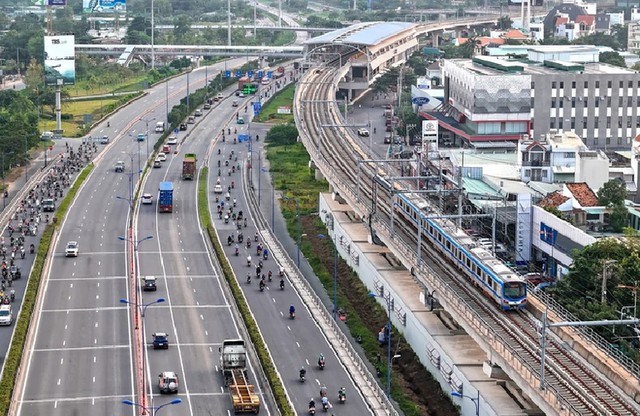
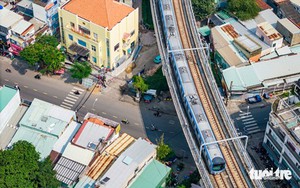
Under its planning orientation, the city’s urban rail network will comprise about 27 lines, requiring an estimated US$104 billion in investment, while around 21,000 hectares are earmarked for transit-oriented development (TOD) by 2035. Photo: Supplied
To address this risk, Nam proposed a four-step process.
First, the city should map the sources of value for each project, distinguishing between gains arising from additional development rights, changes in land use, infrastructure investment, direct station access and the use of public assets. Each charge should then be clearly linked to the specific source of value it is intended to capture.
Third, contributions already made by developers should be recognized and offset against subsequent obligations. Such contributions may take the form of joint development (JD), public-private partnerships (PPP), auction payments, investment in connecting infrastructure or direct contributions to infrastructure.
Finally, rather than assessing each charge in isolation, the city should consider a project’s total financial obligations against its development costs, investment scale, timeline, revenue potential and market risks. A TOD project may simultaneously face obligations related to land, infrastructure, transport connections, social housing, resettlement and environmental requirements.
Nam therefore proposed creating a separate “value and obligation profile” for each TOD project, setting out the sources of value generated, the methods used to calculate them, the corresponding charges or obligations, contributions already made, and the remaining value that could be captured.
This is also consistent with a principle highlighted by Nguyen Ngoc An: “one source of additional value should only be captured once.” If that value has already been reflected in land-use fees, auction prices or another financial obligation, it should be taken into account when determining any subsequent obligations.
From revenue to a cycle of reinvestment
Identifying and capturing part of the value generated by TOD is only half of the equation. The other half is how those resources are used to further support public transport and urban development.
According to Nam, revenue generated through LVC should be transparently reinvested in TOD-related infrastructure and services, including urban rail, station connections, technical and social infrastructure, public spaces, compensation and resettlement, as well as management, maintenance and operations.
This creates a cycle of reinvestment: TOD generates value, part of that additional value is captured through LVC, and the proceeds are reinvested in infrastructure and urban services. These investments, in turn, improve accessibility and help generate further value across TOD areas.
An noted that LVC does not necessarily have to rely solely on charges and fees. The government can also participate through public-private partnerships (PPP) or joint development (JD), with the public sector contributing land, infrastructure or development rights, while private partners provide capital, development expertise and management capacity.
The value subsequently created can then be shared under a predetermined mechanism, with a portion reinvested in transport and urban infrastructure.
International experience shows that this value can be captured in very different ways.
In Hong Kong, the Rail plus Property model integrates rail investment with property development at and around stations. Rather than relying solely on fare revenue, the commercial value created by improved rail accessibility forms part of the project’s financing model. Transport and property development are therefore planned together from the outset, both along rail corridors and around stations.
Singapore takes a different approach, relying more heavily on the government’s role in managing and developing public land. State-owned land around transport hubs can be planned for appropriate uses and development intensity before being released to the market, allowing the public sector to capture part of the value created by planning decisions and infrastructure investment.
London’s Crossrail, meanwhile, illustrates another approach based on sharing the cost of major infrastructure. Rather than placing the entire funding burden on a single party, the project drew resources from multiple stakeholders expected to benefit from the railway and the economic activity it would generate.
While the three cases use different instruments, An said they share a common principle: “transport, land, urban development and finance are considered within the same framework from the outset.”
Vietnam’s new legal framework has given Ho Chi Minh City greater scope to deploy these value-capture tools. The challenge, however, is to turn individual instruments into a coherent mechanism that allows value generated by TOD to flow back into TOD development.
The task therefore goes beyond finding additional revenue for its metro network. It is about creating a cycle in which infrastructure investment generates value, part of that value is reinvested in infrastructure, and development projects remain commercially viable.








Max: 1500 characters
There are no comments yet. Be the first to comment.