


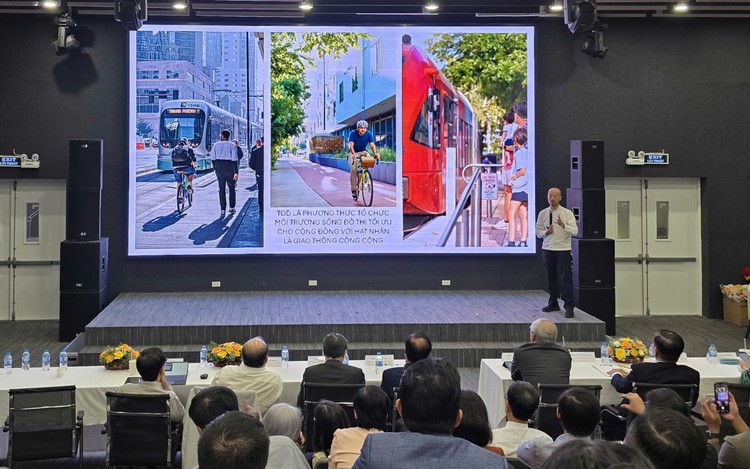
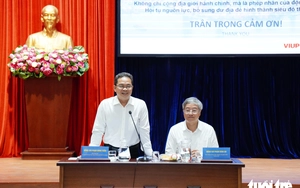
Architect Vu Viet Anh, vice-president of the Ho Chi Minh City Association of Architects, speaks at a seminar titled 'TOD: A factor reshaping urban lifestyles and spaces' in the city, August 28, 2026. Photo: Cong Trieu / Tuoi Tre
The remarks were made at a seminar titled 'TOD: A factor reshaping urban lifestyles and spaces,' held in the city as part of activities ahead of the Vietnam Interior & Build Expo 2026, jointly organized by the Ho Chi Minh City Handicraft and Wood Industry Association, the municipal Association of Construction and Building Materials, and the city's Association of Architects.
TOD and metro are closely linked, with metro lines providing the high-capacity public transport backbone while TOD concentrates housing, jobs, services and other activities around stations to create a large potential ridership base and make it easier for people to walk or cycle to transit, experts said.
Architect Vu Viet Anh, vice-president of the Ho Chi Minh City Association of Architects, said motorbikes remain highly attractive to Vietnamese urban residents because they are convenient, can easily navigate narrow alleys, can be parked at home and are often used directly for livelihoods.
This convenience presents a major challenge for metro systems, he said.
'Having a metro does not mean traffic congestion will disappear,' Anh said, warning that without proper TOD planning, the city could end up with trains running quickly above ground with few passengers while motorbikes remain gridlocked on the streets below.
To persuade people to leave their motorbikes and use the metro, stations should not be designed merely as places to board and leave trains, Anh said.
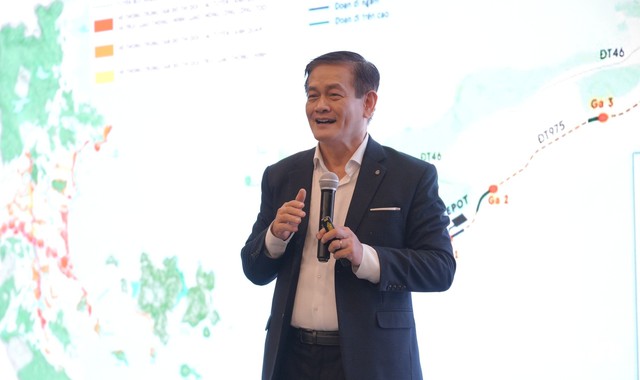
Architect Ngo Viet Nam Son, president of Ngo Viet Architects & Planners, speaks at a seminar titled 'TOD: A factor reshaping urban lifestyles and spaces' in Ho Chi Minh City, August 28, 2026. Photo: Cong Trieu / Tuoi Tre
Instead, they should put pedestrians at the center and offer clear advantages, with metro travel being faster than motorbikes, affordable, punctual, safe and convenient.
Every metro journey should begin and end with a walking trip, he said, making sidewalks and plazas around stations crucial to their success.
Walking routes around stations should be shaded, safe and comfortable enough to encourage people to walk instead of ride motorbikes.
Buildings around stations should also be connected across multiple levels, with underground spaces linked to underground stations and elevated pedestrian bridges connecting stations directly with offices, buildings and shopping centers, Anh said.
Stations should be designed as open, accessible spaces incorporating services, food and beverage outlets and indoor green spaces, he added.
Architect Ngo Viet Nam Son, president of Ngo Viet Architects & Planners, said completing Metro Line 1 was only about one-third of the way toward building a successful metro-based urban transport system.
Although the line has been completed, only a few high-rise developments have emerged along the corridor, while large areas of land remain undeveloped, making it difficult to fully realize the metro's potential, Son said.
Participants attend a seminar titled 'TOD: A factor reshaping urban lifestyles and spaces' in Ho Chi Minh City, August 28, 2026. Photo: Cong Trieu / Tuoi Tre
He proposed that Ho Chi Minh City establish a TOD development corporation as a public-private coordinating body responsible for metro development and the planning, development and auction of land around stations.
Revenue from land around stations could then be reinvested in transport infrastructure, he said.
Son called for the city to urgently establish a complete TOD ecosystem within a 15-minute walk, or about 1.2 kilometers, of each metro station.
Residents in these areas should be able to access essential services such as schools, hospitals, offices, supermarkets and parks, he said.
Such an ecosystem would help increase metro ridership, reduce the number of motorbikes on the roads and thereby ease congestion, Son said.
Son also pointed out that attracting investment in the TOD project planned for the Hang Xanh intersection area in the city's Thanh My Tay Ward is currently not feasible, as current proposals have centered mainly on high-rise buildings rather than a comprehensive TOD model.
To make the project feasible, he said the city should first consider adjusting planned metro connections, including Metro Lines 3 and 5, as well as station locations, to maximize developable land while minimizing compensation and site-clearance costs.
He further noted that previous metro planning in Ho Chi Minh City had focused mainly on transport connections rather than integrating land around stations into TOD planning.








Max: 1500 characters
There are no comments yet. Be the first to comment.