


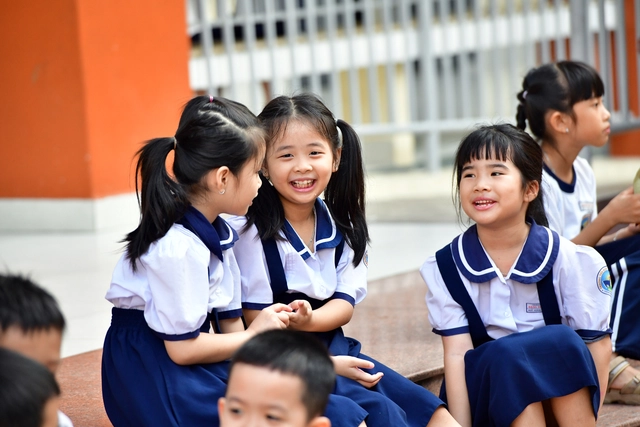
Students of Dang Thuy Tram Elementary School in An Hoi Tay Ward, Ho Chi Minh City. Photo: Duyen Phan / Tuoi Tre
Late last week, the municipal Department of Education and Training issued a warning about homeschooling after some children were found to have been homeschooled from grade 1 through elementary level before seeking admission to school for grade 6.
In addition, there are education centers that claim to be authorized to provide academic education, send teachers to students’ homes, issue their own certificates, and charge tuition of around VND20 million (US$765) per year.
Two expatriate teachers in the southern metropolis, Subhajeet Chatterji, an English teacher with a professional background in learning and development and human resource management, and Lyndon Britanico Badong, a Filipino ESL teacher, have shared their views on the issue with Tuoi Tre News.
Both educators asserted that schooling is more than academic instruction.
Chatterji said that school teaches children to communicate, collaborate, handle disagreements, and function as part of a community. Those experiences are extremely difficult to replicate fully at home.
Badong echoed this sentiment, describing schools as communities where children can develop academically, socially, and emotionally.
“As an educator, I personally prefer formal schooling for my own child,” Badong said, stressing that education is about adapting to diverse people and situations, not just mastering content.
Recognizing homeschooling’s strengths
Despite their support for formal schooling, both teachers acknowledged homeschooling’s advantages.
Chatterji agreed that homeschooling allows children to learn at their own pace and receive more individual attention.
Badong highlighted flexibility, individualized learning, and greater parental involvement as key benefits.
The Filipino teacher also shared that he has friends, mostly expatriates, who homeschool their kids.
“I respect their decision because every child and family has different needs.”
Challenges, risks of homeschooling
The teachers also pointed out significant challenges of homeschooling.
Chatterji warned against unregulated providers charging substantial fees and issuing their own certificates without government recognition.
“Children’s education is too important to be left to unregulated providers,” he said.
He urged parents to verify accreditation, teacher qualifications, and assessment methods before trusting any program.
Badong added that homeschooling requires substantial time, resources, and commitment from parents, and carries a risk that children may have fewer opportunities to interact with their peers from different backgrounds.
Recommendations for parents
Both educators advised parents in Vietnam to prioritize formal schooling whenever possible.
Chatterji encouraged parents to choose full-time formal schooling first and exhaust all suitable school options before considering homeschooling.
If homeschooling is still necessary, parents should ensure there is a genuine reason for it, verify that any education provider has clear government recognition and qualified teachers, and make sure the child has regular opportunities for social interaction.
Badong agreed that homeschooling can be a valid option, particularly for children with special educational needs or those facing bullying, but stressed that the chosen approach must genuinely meet the child’s educational, social, and developmental needs.
Supporting transitions
The teachers also called for support for children moving from homeschooling into formal schools.
According to Chatterji, children entering formal schools after homeschooling may need time to adjust to a new environment, routines, and peer relationships.
He recommended that schools and teachers welcome them warmly, identify their needs without judgement, and help them build confidence and a sense of belonging.
Empathy, patience, and support, he said, are essential to easing this transition.
- REFERENCE MORE








Max: 1500 characters
There are no comments yet. Be the first to comment.