


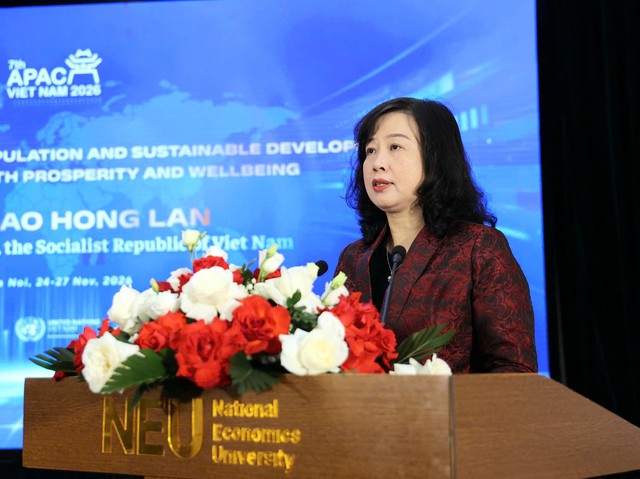
Minister of Health Dao Hong Lan speaks at the conference. Photo: T. Minh / Tuoi Tre
Speaking at an international conference on population and sustainable development in Hanoi, which runs from November 24 to 27, Vietnamese Minister of Health Dao Hong Lan highlighted Asia's growing demographic challenges.
Asia remains the world's most populous region, with around 4.8 billion people, accounting for 58.7 percent of the global population.
However, its fertility rate has fallen sharply over the past five decades, from around 5.25 children per woman in 1975 to 1.87 today.
Mounting pressures from population aging
Many Asian countries are grappling with persistently low fertility rates, aging populations, and even population decline. Others, however, are still benefiting from a demographic dividend, with opportunities to leverage their workforce and consumer markets.
While these demographic shifts offer development opportunities, they also pose significant challenges, she said.
These include maintaining appropriate fertility levels, improving workforce quality, ensuring sustainable employment, adapting to population aging, providing elderly care, managing migration, and strengthening social protection.

The conference attracts population and development scholars from more than 100 universities worldwide. Photo: T. Minh / Tuoi Tre
Vietnam is facing similar challenges, with its fertility rate declining to around 1.93 children per woman and its population aging rapidly, even as the country remains in its demographic dividend period, the minister pointed out.
In response, Vietnam has shifted its population policy from a focus on family planning toward a more comprehensive approach addressing population size, structure, distribution, and quality.
Financial incentives alone are not enough
Professor Nguyen Thien Nhan, a former Politburo member, former secretary of the Ho Chi Minh City Party Committee, and former deputy prime minister, warned that prolonged below-replacement fertility could fundamentally alter population structures, with far-reaching economic and social consequences.
Drawing on demographic data from Japan, South Korea, China, and other countries, Professor Nhan identified 11 factors contributing to persistently low fertility rates.
These include easy access to contraception, high living costs, long working hours, shortages of public schools, particularly preschools, and gender inequality both at home and in the workplace.
Other factors include concerns over economic stagnation and job insecurity, delayed marriage and childbearing, ineffective government support programs for marriage and child-rearing, high infertility treatment costs, and workplace discrimination against women.

Professor Nguyen Thien Nhan speaks at the conference. Photo: T. Minh / Tuoi Tre
Professor Nhan also pointed to the emergence of what he described as a ‘three-no’ generation, referring to people who choose not to marry, have children, or assume responsibility for addressing population decline.
Despite recognizing these factors and spending tens of billions of U.S. dollars annually on family support programs, 44 high-income and 20 middle-income countries have failed to bring their fertility rates back to replacement levels, according to Nhan.
These countries collectively account for 68 percent of the world's population and 86 percent of global GDP.
Addressing the root causes
Professor Nhan identified four fundamental shortcomings that need to be addressed to reverse persistently low fertility rates.
First, government and business leaders have yet to recognize maintaining a sufficiently large population of reproductive age as a prerequisite for sustainable development.
Second, national leaders have not adequately highlighted the long-term consequences of below-replacement fertility or clearly acknowledged the responsibilities of governments and businesses in tackling the issue.
Third, workers earning the minimum wage or less than 1.5 times that amount do not earn enough to support a family of four with two working adults and two children.
Finally, many people lack the knowledge and skills needed to build and maintain a happy family of four.
He recommended that countries develop population projections spanning around 300 years, identify the root causes of persistently low fertility rates, and introduce policies early to address these challenges with a long-term perspective.


Max: 1500 characters
There are no comments yet. Be the first to comment.