


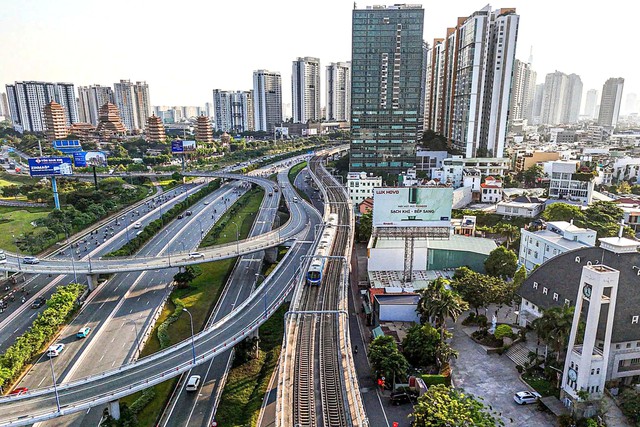
Ho Chi Minh City’s metro line No.1, known as Ben Thanh-Suoi Tien, which began operations in late 2024, has provided fresh momentum for Ho Chi Minh City’s development. Photo: Quang Dinh / Tuoi Tre
Without the roar of motorbikes, exhaust fumes, or the constant need to watch the road ahead, the city seemed to move more slowly beyond the train window.
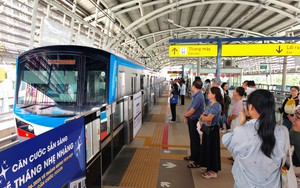
Bridges, rivers, neighborhoods, greenery, and familiar buildings appeared in a different composition.
I have used metro systems in cities including Moscow, Kaohsiung, and New Delhi, and each offered a different way to understand the urban environment.
But metro line No. 1 made me curious about the city I have lived in long enough to think I already knew well.
What does Ho Chi Minh City look like from a metro window?
From motorbike to metro
I parked my motorbike near the park and followed a covered walkway to Ben Thanh Station.
For someone long accustomed to traveling around Ho Chi Minh City by motorbike, leaving it behind and entering the metro still felt unusual.
Above ground, Ben Thanh Market was as busy as ever. Below it was a different world of tracks, platforms, and passengers still learning how to use a relatively new form of public transport.
At the center of the station, a lotus-shaped skylight allows natural light to fall onto a ceramic clock bearing the words 'HCMC METRO.'
It felt symbolic.
A city long dominated by motorbikes is beginning to adopt a different rhythm of movement, starting from its very center.
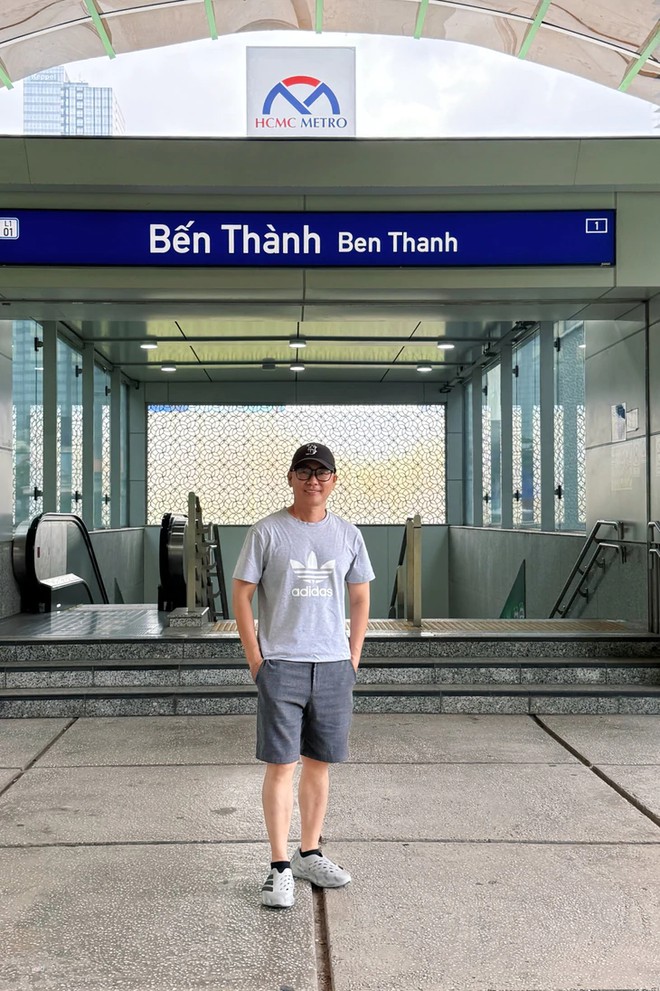
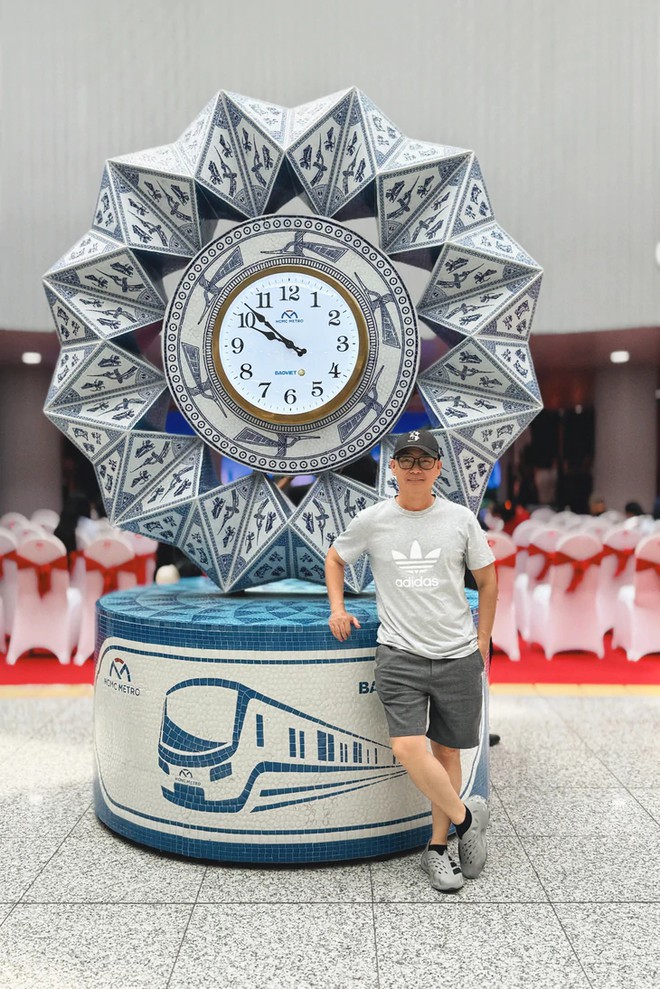
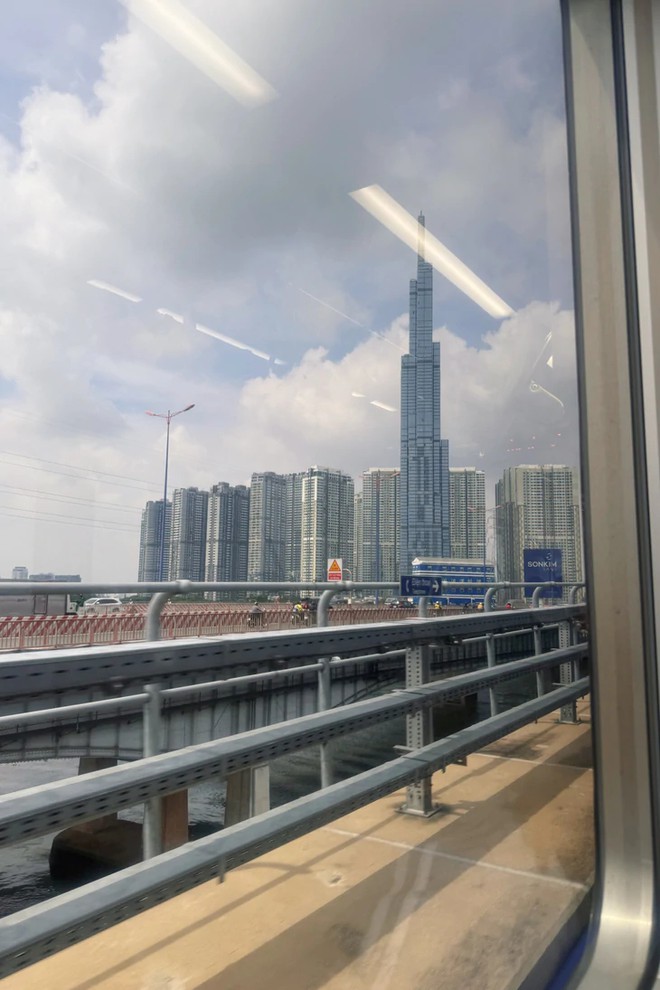
Photos taken by author Nguyen Hoang Bao at metro line No. 1 stations and aboard the train
A different view of Ho Chi Minh City
Then the train began to move.
A young woman's southern Vietnamese voice came over the speakers, calmly announcing the next station. I liked that feeling. It was distinctly modern, yet there was still something about it that felt unmistakably local.
The train left the downtown area, passed Ba Son, crossed the Ba Son Bridge area, and then the Saigon River came into view.
From above, Landmark 81 rose amid patches of greenery and new urban developments. Farther away were Thao Dien, An Phu, rooftops, rows of trees, and open spaces that I rarely have the chance to see all at once when traveling by motorbike at street level.
I realized that the metro does not simply change the way we travel. It changes the position from which we see the city.
On a motorbike, I am inside the traffic, constantly watching the vehicles ahead, the intersections, the horns, and the gaps I can weave through.
On the metro, I am outside that flow.
The city glides past the window, and I have time to look at it.
Metro line No. 1 does not need to resemble any other subway or metro system in the world, from the oldest networks to the most modern ones. It can create a perspective of Ho Chi Minh City that is entirely its own.
I also found myself noticing very ordinary things that people do not always think about when discussing a modern transport project.
Restrooms are available at the stations, along with facilities for people with disabilities and families with young children. These details may not make for beautiful photographs that prompt people to stop and take pictures, but they play a major role in determining how people experience a public transport system.
By the time I reached the end of the line, I was in a very different state of mind from when I had started.
Ho Chi Minh City was still made up of the same streets, buildings, and river. But the viewpoint had changed.
And sometimes, simply changing the observer's position can make a familiar city appear like an entirely different one.
How stations tell a city’s story
Metro systems can also reflect the character of the cities they serve.
In Moscow, many stations are known for elaborate columns, vaulted ceilings, reliefs, chandeliers, and decorative details. Commuting there can sometimes feel like passing through an underground architectural museum.
In Kaohsiung, Taiwan, Formosa Boulevard Station is home to the Dome of Light, a vast public artwork that turns an everyday transit space into a cultural destination.
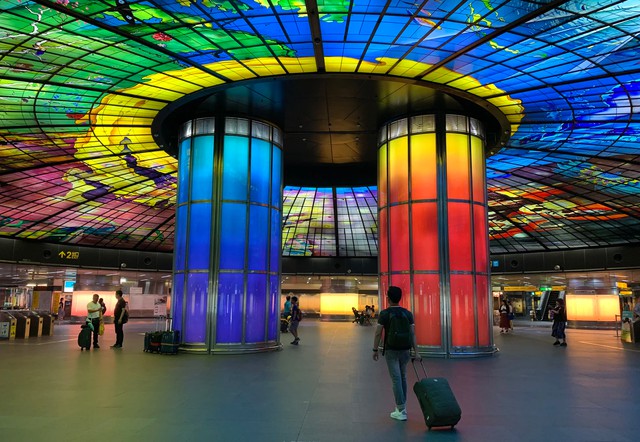
Formosa Boulevard Station is an underground architectural masterpiece in Kaohsiung, drawing visitors with its spectacular stained-glass Dome of Light, which tells an inspiring story about love and life. Photo: Nguyen Hoang Bao
In New Delhi, what stood out to me was connectivity.
The Airport Express links Indira Gandhi International Airport with central New Delhi, allowing passengers to move quickly between the airport, the city, and other transport networks.
Each city, in its own way, tells part of its story through its metro.
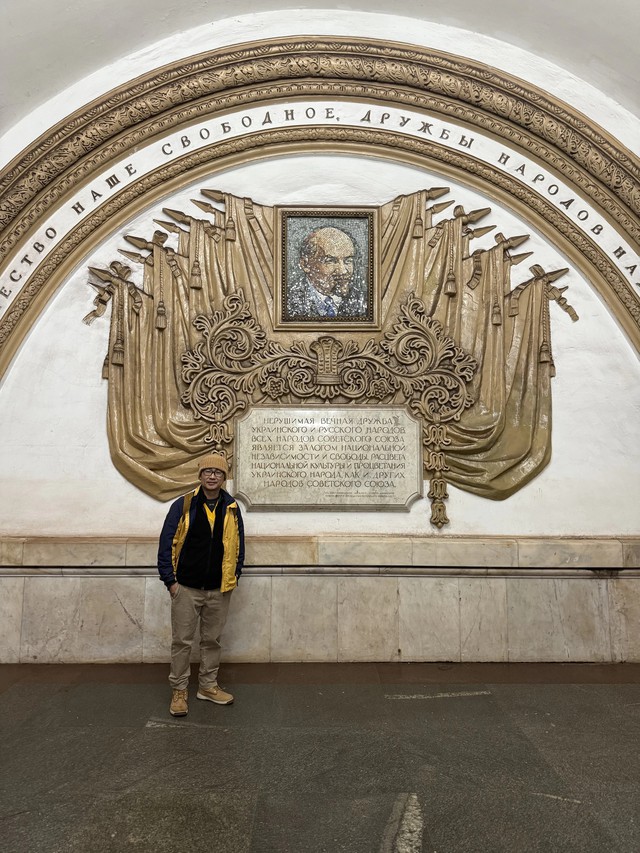
Kievskaya Station in Moscow resembles an underground palace of art, highlighted by a large relief featuring a mosaic portrait of Vladimir Lenin. Photo: Nguyen Hoang Bao
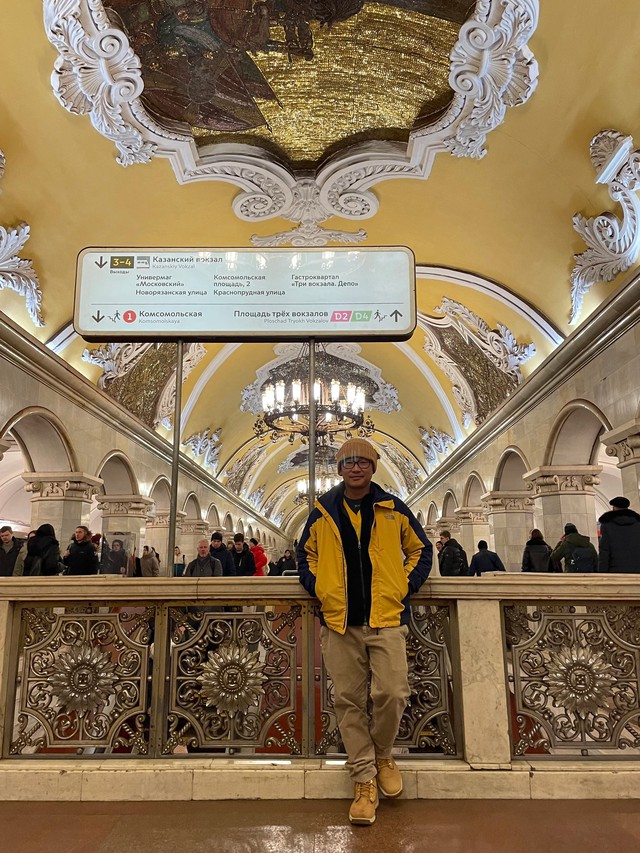
Komsomolskaya Station on Moscow’s Koltsevaya Circle Line showcases ornate Baroque architecture, with a glowing yellow vaulted ceiling, rows of crystal chandeliers, and mosaic panels celebrating Russian history. Photo: Nguyen Hoang Bao
So what story will Ho Chi Minh City tell?
For me, part of that story is already visible in the young volunteers in blue shirts stationed along metro line No. 1. They patiently show passengers how to buy tickets, enter the platforms, board trains, and get off at the right station.
In the middle of a modern transport system, there is something distinctly familiar about one person helping another navigate something new. That, too, feels very much like Ho Chi Minh City.
Ho Chi Minh City has always been that kind of place. Even on its crowded streets, people will often stop to give directions, lend someone a hand, or simply tell a stranger where to turn.
It is a small but notable shift in urban culture, because a public transport system only truly becomes part of a city when people begin to develop shared habits within it.
Then I began to think about time.
When traveling by motorbike, the duration of a journey is often measured by the feel of the traffic, whether an intersection is congested or a stretch of road has suddenly cleared.
With the metro, time becomes more concrete. You know which train is coming, how many minutes the journey will take, when you need to leave home, and when you can expect to arrive.
The journey from Ben Thanh to the terminal station is therefore more than the distance between the two ends of the line. It is also an experience of a different urban rhythm, one in which the city is beginning to adjust to train schedules and the punctuality of public transport.
Over time, the stations themselves may become new social landmarks in Ho Chi Minh City.
One day, instead of arranging to meet at a familiar coffee shop or intersection, people may simply say: meet me at Ben Thanh Station, get off at Thao Dien Station, or wait by Exit 3.
At that point, a station is no longer just a point on a transport map. It becomes part of the language of everyday life, much like the streets, markets, and familiar street corners that have long shaped the way people locate one another in the city.
I do not know how much metro line No. 1 will ultimately change Ho Chi Minh City.
But through the train window that day, I saw a city moving in a new direction while holding on to many familiar things: the voice echoing through the carriage, the volunteers in blue at the stations, the river still flowing beneath Ba Son Bridge, and the rooftops and rows of trees still where they have always been.
The only difference was that I was seeing them from a different height and at a different pace.
And as the urban rail network continues to expand, improving connections with major transport hubs such as Long Thanh International Airport, that story will no longer be limited to residents traveling from Ben Thanh to another terminal station.
It could become part of a much longer journey, bringing the city closer to destinations beyond Vietnam’s borders.
Ho Chi Minh City will still have its motorbikes, sudden rain showers, and crowded streets.
But alongside all those familiar things, the city now has another set of tracks along which to travel farther.
And from a station beneath Ben Thanh, one day residents may begin journeys out into the wider world through these very same windows.


Max: 1500 characters
There are no comments yet. Be the first to comment.