
Beyond cheap prices, what will it take for Vietnam to win big in the $125 billion US furniture market?
Competitive prices alone are no longer enough for Vietnamese exporters seeking a bigger slice of the $125 billion US furniture market. As consumer preferences shift and competition intensifies, what should businesses focus on to gain a stronger foothold in this market?

A delegation of Vietnamese businesses attends High Point Market 2026, an international furniture and home furnishings trade fair in the U.S., in October 2026. Photo: Vietnam Trade Office in the U.S.
Do Ngoc Hung, Vietnam's trade counselor in the United States, outlined key considerations following discussions with American industry experts, trade associations, and distributors at High Point Market 2026 in North Carolina.
At the event, 16 Vietnamese businesses showcased wooden furniture, handicrafts, rattan and bamboo products, and home décor at a national pavilion spanning more than 300 square meters.
Innovation key to gaining market share
The U.S. remains Vietnam's largest export market for wood and wood products, with shipments reaching approximately $5.91 billion in the first eight months of 2026, accounting for 50.1 percent of the industry's total export revenue.
However, the Vietnam Trade Office in the U.S. said manufacturing capacity and competitive pricing alone are no longer sufficient to maintain an edge in the market.
A sluggish housing market, cautious consumer spending, and uncertainty over U.S. trade policies are making it increasingly important for suppliers to differentiate their products.
The trade office urged Vietnamese manufacturers to invest in research and development, particularly in upholstered furniture, adjustable and reclining products, and furniture with integrated technology.
It also recommended collaborating with American designers early in the development process to better meet local preferences, increase product value, and reduce reliance on price-based competition.
Local distribution becomes competitive advantage
Beyond product innovation, Vietnamese exporters need to establish a stronger presence in the US market, particularly through distribution networks, warehousing, and customer services.
According to the trade office, many American retailers cannot or prefer not to import full shipping containers directly from Asia, while lengthy delivery times can make overseas suppliers less attractive.
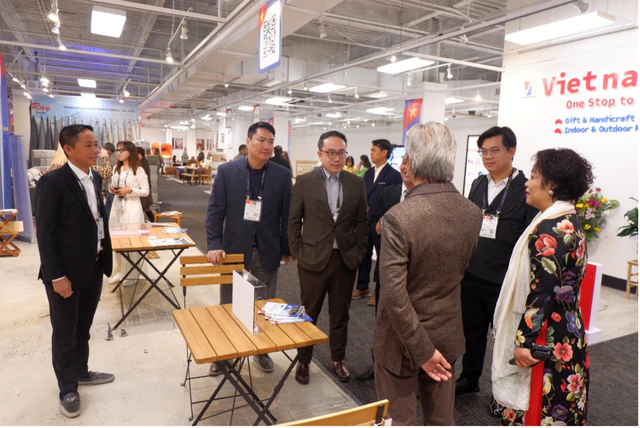
Vietnamese businesses showcase a diverse range of products at High Point Market 2026 in the U.S. Photo: Vietnam Trade Office in the U.S.
Companies capable of fulfilling smaller orders from U.S.-based warehouses and delivering products quickly are therefore better positioned to reach local retailers.
Vietnamese businesses were advised to consider partnerships with independent sales representatives, distributors, and logistics providers, as well as investing in local warehouses where financially feasible.
Meanwhile, shifting U.S. tariff policies are making it harder for importers and retailers to forecast costs and plan their operations.
American buyers are consequently placing greater emphasis on suppliers that can offer reliable delivery schedules, stable business relationships, and flexibility in responding to market changes.
The trade office urged Vietnamese exporters to stay updated on tariff and import regulations, monitor logistics costs, and work closely with U.S. partners to adjust shipment schedules and order volumes when necessary.
U.S. furniture demand shows 'hourglass' pattern
The U.S. business-to-business furniture and home furnishings market is valued at approximately $125 billion, with annual growth of just 1-2 percent.
Despite the modest growth, the market continues to offer substantial opportunities for Vietnamese exporters, although consumer demand is becoming increasingly polarized.
Industry experts describe the trend as an "hourglass" market, with relatively resilient demand for premium furniture and continued interest in affordable, value-for-money products.
Meanwhile, mid-range and upper-mid-range furniture are facing growing pressure as high housing prices and rising living costs prompt American consumers to delay purchases.
Consumer preferences are also shifting toward furniture that combines design, functionality, and technology.
Sofas and reclining chairs with adjustable positions, built-in massage features, charging ports, and other wellness-related functions are attracting growing interest.
For Vietnamese exporters, these trends underscore the need to move beyond low-cost manufacturing and focus on innovation, flexible supply chains, and closer connections with American buyers.

Ngoc Nguyen - Ngoc An - Nghi Vu / Tuoi Tre News