
Durian orchards in Vietnam's Mekong Delta face months-long saltwater intrusion threat
Durian-growing areas in Vietnam's Mekong Delta provinces of Dong Thap and Vinh Long face the risk of prolonged saltwater intrusion during the 2026-27 dry season, which could be as severe as the historic 2019-20 drought and salinity crisis, according to a water-resource scenario released by the Ministry of Agriculture and Environment.
El Nino, a climate phenomenon characterized by unusually warm sea-surface temperatures in the central and eastern tropical Pacific, is expected to intensify saltwater intrusion, putting thousands of hectares of orchards under pressure from freshwater shortages.
In Dong Thap, saltwater from the Tien River could penetrate beyond existing salinity-control infrastructure and reach Ngu Hiep and Hiep Duc Communes, two major durian-growing areas.
According to the ministry's forecast for the Mekong River basin during the 2026-27 dry season, saltwater intrusion could be as severe as that recorded in 2019-20, with salinity levels at some river mouths potentially spiking even higher.
Ngu Hiep and Hiep Duc are expected to have limited opportunities to access fresh water in February and March 2027.
In Vinh Long, saltwater moving along the Ham Luong River could reach the areas of Tien Thuy, Tan Phu and Cho Lach, while intrusion along the Co Chien River could extend to Quoi Thien, Quoi An and Nhuan Phu Tan.
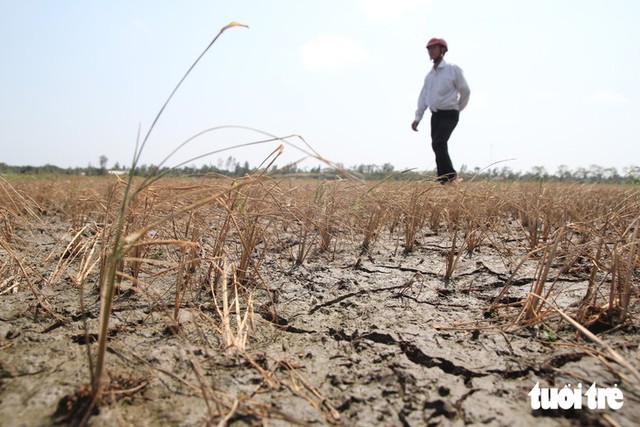
A farmer walks across a parched rice field in Vinh Long Province, Vietnam's Mekong Delta, amid water shortages during a previous dry season. Photo: Mau Truong / Tuoi Tre
The province expects saltwater intrusion to peak between February and May 2027, putting considerable pressure on fruit-growing areas whose crops are particularly sensitive to salinity.
Local authorities in Cho Lach have warned that durian trees and ornamental plants are highly sensitive to salt, with salinity levels exceeding 0.3 parts per thousand potentially causing serious damage and preventing farmers from drawing water for irrigation.
Authorities step up measures to protect orchards
Dong Thap and Vinh Long are preparing measures to protect fruit-growing areas, particularly those cultivating durians, from saltwater intrusion.
In Dong Thap, authorities are focusing on adjusting crop schedules, dredging canals and operating irrigation systems and salinity-control sluice gates.
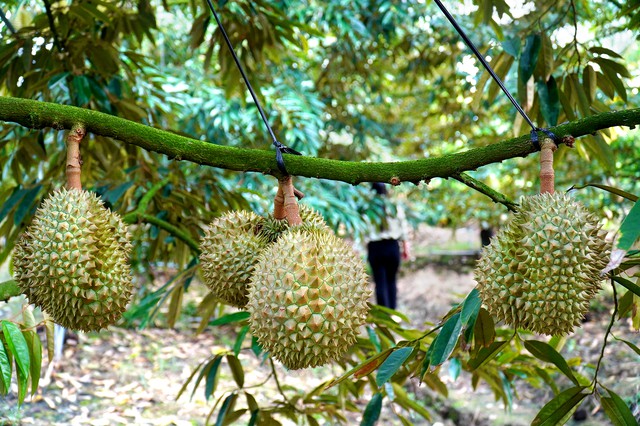
Durian fruits hang from a tree in an orchard in Dong Thap Province, Vietnam's Mekong Delta. Photo: Mau Truong / Tuoi Tre
The province is also preparing to build temporary dams across the Ba Rai and Phu An rivers and in the Hiep Duc islet area if necessary.
Agricultural authorities are encouraging fruit growers to use water economically and store fresh water in ponds and garden canals.
Other contingency measures include dredging raw-water reservoirs, operating backup groundwater wells, providing water storage tanks and transporting fresh water from upstream areas by barge if local supplies run dry.
In Vinh Long, authorities are prioritizing infrastructure projects in the former Ben Tre area to strengthen salinity control.
The province currently manages nearly 9,800 sluice structures and more than 10,000 canal routes, according to local authorities.
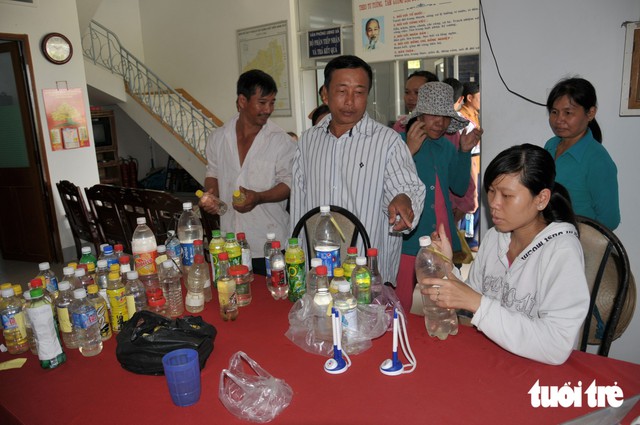
Residents in a durian-growing area in Vietnam's Mekong Delta bring river water samples to their commune office for salinity testing before irrigating their orchards during the 2015-16 dry season. Photo: Mau Truong / Tuoi Tre
Its agriculture sector is reviewing the dyke system and accelerating key sluice-gate projects, including Vam Thom and Vam Nuoc Trong, to gradually complete the salinity-control network.
A leader of the Vinh Long Department of Agriculture and Environment said El Nino typically brings higher temperatures, below-average seasonal rainfall, drought, water shortages and saltwater intrusion to the province.
The department will assign officials to regularly monitor saltwater intrusion in durian-growing areas, particularly at water intake gates, the official said.
It will also coordinate the flexible operation of irrigation infrastructure to meet local water demands as much as possible, supporting both agricultural production and residents' daily needs.
- REFERENCE MORE
- REFERENCE MORE
- REFERENCE MORE
Vinh Tho - Mau Truong - Khac Tam / Tuoi Tre News
Link nội dung: https://news.tuoitre.vn/durian-orchards-in-vietnams-mekong-delta-face-months-long-saltwater-intrusion-threat-103261120211314017.htm