
Removing foreigners' right to own individual houses unlikely to greatly affect Vietnam property market: experts
The proposed removal of foreigners' right to own individual houses in Vietnam is expected to have little impact on the property market, as the number of such houses owned by foreign organizations and individuals remains small and foreigners would still be allowed to own condominium apartments, according to real estate experts.
The assessment came after the Ministry of Construction included a proposal in its latest draft amendment to the Housing Law to remove the right of foreign organizations and individuals to own individual houses, including villas and townhouses.
Nguyen Duy Thanh, vice-chairman of the Ho Chi Minh City Association of Condominium Apartment Management and Operation, said the proposed change would have little impact on the property market because the number of individual houses currently owned by foreigners is insignificant compared with the overall housing market.
He said the change should be viewed mainly as an adjustment to land management rather than a measure directly targeting the property market.
Individual houses are closely associated with specific residential land parcels, while condominium apartments are linked to shared land-use rights within housing projects, Thanh explained.
Removing foreigners' right to own individual houses would therefore help separate housing ownership from land-use rights and make land management more consistent, he said.
The proposal is in line with Resolution No. 21-NQ/TW, issued by the Party Central Committee on July 28, which sets directions for amending the Land Law and related legislation.
The resolution states that land is under public ownership, with the state acting as the representative owner and exercising unified management; land must under no circumstances be privatized; and foreigners shall not be allowed to receive transfers of land-use rights in any form, except in cases involving people of Vietnamese origin residing overseas.
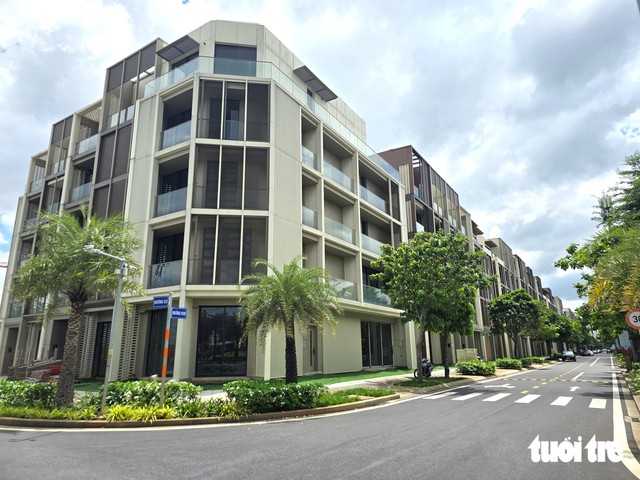
A view of a project in eastern Ho Chi Minh City, one of five housing projects where foreigners are allowed to own homes, as recently announced by the Ho Chi Minh City administration. Photo: Cong Trieu / Tuoi Tre
Thanh said removing the right to own individual houses could help prevent situations in which ownership of a house is directly associated with rights over a specific residential land parcel.
The proposed change, however, would not prevent foreigners from owning homes in Vietnam, as they would still be allowed to own condominium apartments, Thanh said.
He explained that the draft retains the rights of foreign organizations and individuals to buy, lease-purchase, receive as gifts or inherit condominium apartments, with foreign ownership capped at 30 percent of the total number of apartments in each condominium building.
In addition, the homes owned by foreign organizations and individuals would have to be located in housing projects outside areas subject to national defense and security restrictions.
Vo Thanh Dang, vice-chairman of the Association of Vietnamese Entrepreneurs Overseas, also said the proposed change would have only a limited direct impact on the property market because foreign ownership of individual houses is currently small.
Dang said the proposal was more about clarifying the relationship between housing ownership and land-use rights than restricting foreigners' access to Vietnam's housing market.
He noted that some countries, including Singapore and New Zealand, also impose restrictions on foreign ownership of landed housing.
However, Dang said foreign investors could be concerned if the policy change lacked a clear transition mechanism.
He called for clear distinctions between foreign nationals, Vietnamese citizens residing overseas, people of Vietnamese origin residing overseas, and Vietnamese citizens holding foreign nationality.
He also suggested simplifying and digitizing procedures for verifying Vietnamese origin and applying consistent procedures nationwide.
At the same time, Dang said the amended law should ensure full protection of property rights, including transfer, gifting, mortgage, and inheritance, for foreigners who were previously granted lawful ownership certificates under the regulations in effect at the time.



Vinh Tho - Cong Trieu / Tuoi Tre News