
Vietnam raises prison terms for insulting others, criminalizes crypto asset violations
Vietnam's National Assembly has passed a revised Penal Code that increases the maximum prison sentence for insulting others and introduces new criminal offenses involving crypto assets and crypto asset markets.
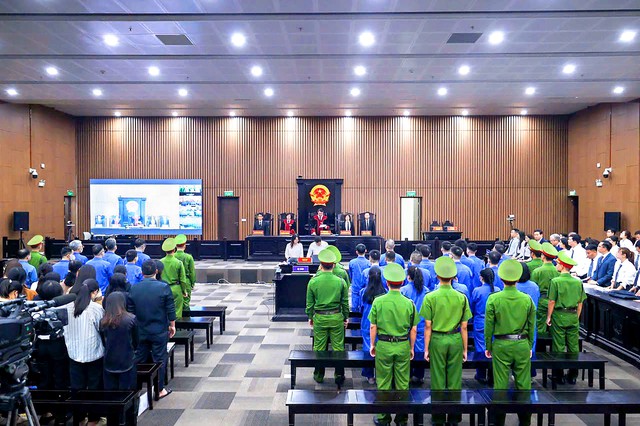
A court hearing in Hanoi. Photo: Supplied
The revised code, comprising 417 articles, was passed at the legislature's second sitting and will take effect on March 1, 2027.
Harsher penalties for insulting others
The revised Penal Code increases prison sentences for insulting others compared with the current code, which stipulates a prison term of 2-5 years under the most severe penalty bracket.
Under Article 138 of the revised code, anyone who seriously insults another person's dignity or honor faces a warning, a fine of VND20 million (US$775) to VND60 million ($2,324), up to three years of non-custodial reform, or three months to two years in prison.
Offenders face one to three years in prison if they commit the offense twice or more, target two or more people, abuse their positions or powers, target individuals performing official duties, or target those who educate, raise, care for, or provide medical treatment to them.
The same prison terms apply to those who use cyberspace to commit the offense or cause mental and behavioral disorders in victims resulting in a bodily impairment rate of at least 31 percent but below 61 percent.
The most severe penalty is three to seven years in prison, applicable to offenders who cause mental and behavioral disorders in victims resulting in a bodily impairment rate of 61 percent or higher, or drive victims to suicide.
New criminal offense involving crypto assets
Article 190 of the revised Penal Code introduces a new criminal offense for violations of regulations governing crypto assets and crypto asset markets.
The provision aims to impose strict penalties for the unlawful issuance of crypto assets, unauthorized provision of crypto asset services, insider trading, and crypto asset market manipulation causing substantial losses.
Acts subject to criminal prosecution include unlawfully offering or issuing crypto assets, providing unauthorized crypto asset services, using insider information to buy or sell crypto assets, and manipulating crypto asset markets.
They also include organizing or conducting transactions, or acting as an intermediary for others to buy, sell, exchange, gift, or use crypto assets for unlawful purposes.
Under the first penalty bracket, offenders face criminal prosecution if they generate illicit profits of VND500 million ($19,369) to less than VND2 billion ($77,477) or cause property losses of VND1 billion ($38,739) to less than VND5 billion ($193,694), provided their conduct does not fall under other provisions of the code.
Penalties include fines of VND2 billion ($77,477) to VND5 billion ($193,694), up to three years of non-custodial reform, or six months to three years in prison.
Those who commit the offense in an organized or professional manner, generate illicit profits of at least VND2 billion ($77,477), cause losses of at least VND5 billion ($193,694), or engage in dangerous recidivism may face fines of VND5 billion ($193,694) to VND10 billion ($387,387) or three to seven years in prison.
Commercial legal entities held criminally liable for the offense may face fines of VND5 billion ($193,694) to VND20 billion ($774,774) and, depending on the applicable penalty bracket and the nature of the offense, may also face permanent suspension of operations.
Real estate market manipulation remains outside the new provisions
In a report submitted before the code was passed, the government acknowledged proposals to criminalize real estate market manipulation, given its potential to cause substantial losses and undermine macroeconomic stability and the credit system.
However, the drafting agency stressed that criminal intervention in the real estate market requires caution to avoid criminalizing legitimate economic activities.
Unlike securities or listed commodities, real estate lacks standardized pricing benchmarks, with property values influenced by supply and demand, market expectations, infrastructure development, urban planning, and market sentiment.
These factors make it difficult to identify and prove manipulation or establish quantitative criteria distinguishing legitimate investment from artificial price inflation and fabricated supply and demand.
The agency noted that practices commonly regarded as real estate market manipulation often involve spreading false information to create artificial land price booms and drive up property values in specific areas for illicit gains.
Such conduct, it explained, constitutes fraud or deception rather than market manipulation in the strict sense and can already be prosecuted under existing criminal provisions if the relevant legal criteria are met.


Ngoc Nguyen - Thanh Chung / Tuoi Tre News
Link nội dung: https://news.tuoitre.vn/vietnam-raises-prison-terms-for-insulting-others-criminalizes-crypto-asset-violations-103261125204433118.htm