


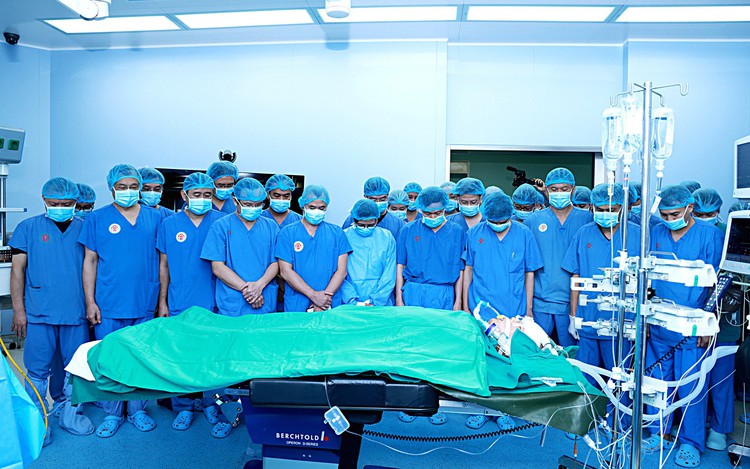
Doctors and other medical workers observe a moment of silence in tribute to an organ donor in Vietnam. Photo: Tuoi Tre
The ministry issued the statement in a press release following the law's passage by the National Assembly in Hanoi on Saturday.
The law consists of seven chapters and 39 articles, setting out regulations on the donation, retrieval, preservation, storage and transplantation of human tissues and organs, as well as the donation and use of human bodies for humanitarian, medical treatment, teaching and research purposes.
It specifies 29 groups of prohibited acts, including appropriating, buying or selling human tissues, organs or bodies; enticing, deceiving, threatening or coercing people into donating; and exploiting adoption, guardianship, alternative care or dependent relationships to obtain donations.
The law prohibits the retrieval, transplantation, use or storage of human tissues and organs for commercial purposes, as well as advertising or brokering such activities for financial gain.
It also bans organizing or facilitating Vietnamese citizens' travel abroad to buy or sell human tissues or organs, and bringing foreigners to Vietnam for illegal transplantation.
The revised law will take effect on January 1, 2028, according to the health ministry.
Stricter safeguards for living donors
The law prohibits retrieving tissues that cannot regenerate or organs from people under 18.
People aged 18 to under 25 may donate only to family members, while those aged 25 or older may also donate to non-family members, with the allocation of organs to non-family recipients handled by the national coordination authority rather than chosen by the donor.
Living donors must receive independent legal and health counseling and undergo psychological and social assessments before donating.
The professionals conducting these assessments must not be the doctors prescribing the transplant or those directly counseling the donors.
Each case must also be reviewed and approved by an advisory council comprising medical, legal and psychological experts who are independent of the donation and transplantation process.
Police and local authorities are responsible for verifying the donor's relationship with the intended recipient and confirming residence information.
The law also sets out a minimum marriage-duration requirement for spouses donating tissues or organs to each other.

Vietnamese Minister of Health Dao Hong Lan. Photo: Vietnam’s National Assembly
New rules on circulatory-death donation
In addition to donation after brain death, the revised law recognizes organ donation after circulatory death.
Circulatory death is defined as irreversible loss of circulatory and respiratory functions.
The health ministry said the practice has been safely implemented in many countries for years and could increase the supply of organs from deceased donors, reduce reliance on living donors, protect public health and help curb organ trading and coercion.
The determination of brain death and circulatory death must follow professional procedures and standards to ensure objectivity and independence.
Members of a brain-death determination council must not simultaneously serve as the donor's treating doctors, donation counselors or members of the organ retrieval or transplantation team.
Organ allocation and donor rights
The law provides for a national coordination authority and a database to manage organ donation and transplantation nationwide.
Organs must be allocated according to compatibility and criteria that ensure fairness, transparency and objectivity, without discrimination based on financial circumstances, ethnicity, beliefs, religion, gender or place of residence.
Allocation criteria include the urgency of the recipient's medical condition, expected transplantation outcomes and other professional factors, as well as the recipient's characteristics and waiting time.
Priority is given to children, people who have previously donated organs, and certain relatives of deceased donors whose deaths have been determined by brain or circulatory criteria.
Donors' personal information must be encrypted and kept anonymous, except where disclosure is required by law.
People aged 18 or older may register to donate their tissues, organs or bodies and may change, cancel or renew their registration.
Registration does not automatically mean a person is eligible to donate.
Donors or their legal representatives, as well as biological parents where applicable, may refuse donation at any time.
If a refusal or disagreement arises, the donation and retrieval must not proceed.
Donor support and recognition
The law also provides for healthcare and recovery support for donors, including medical checkups and health insurance premium support.
Medical facilities receiving donated bodies must ensure respectful treatment, including restoring the body's appearance and arranging burial or the handover of the body or ashes in accordance with the family's wishes.
Under the law, May 20 will be observed annually as the Day of Gratitude to Tissue and Organ Donors to honor donors and their families and promote the humanitarian values of organ and tissue donation.
Existing donation registrations, donor cards and waiting lists will remain valid and be transferred to the new database.
The national database is expected to be completed before December 31, 2028.




Max: 1500 characters
There are no comments yet. Be the first to comment.