
Vietnam’s agro-forestry-fishery exports turn tables, hit $70bn in 2025
Vietnam’s agro-forestry-fishery exports staged a dramatic gain in 2025, setting a new record of more than US$70 billion, well above the $65 billion target and nearly $8 billion higher than the previous year.
The Ministry of Agriculture and Environment attributed the breakthrough to a combination of proactive responses to shifting tariff regimes, swift handling of food safety incidents, the removal of technical barriers, and the timely resolution of bottlenecks, most notably those affecting durian exports to China.
Within the export picture, fruits and vegetables stood out, generating $8.6 billion in revenue, up nearly 20 percent despite global volatility.
This marked the third consecutive year the sector had set a new record while maintaining double-digit growth.
According to the Vietnam Fruit and Vegetable Association (Vinafruit), China remained Vietnam’s largest fruit and vegetable buyer in 2025, making up more than 60 percent of the latter's total fruit and vegetable exports.
Shipments to the United States also rose sharply, up more than 50 percent to around $500 million despite the impact of tariff policies.
Other major markets such as Japan, South Korea, the Netherlands, and Australia also recorded a steady expansion.
Growth was fueled primarily by key fruits such as durians, bananas, mangoes, jackfruit, coconuts, and pomelos.
Durians continued to play a pivotal role, leading the sector with export earnings hitting $4 billion.
Dang Phuc Nguyen, secretary general of Vinafruit, told Tuoi Tre (Youth) newspaper that exports plunged 30-50 percent year on year in the first quarter and early second quarter of 2025 after China tightened controls on banned substance residues.
Meanwhile, news of potential reciprocal tariffs from the U.S. dampened business sentiment, leading many to doubt that the sector could meet its annual target of $7.6 billion.
That outlook changed in the second half of the year.
Coordinated efforts by the government, the Ministry of Agriculture and Environment, and the Ministry of Industry and Trade, including high-level delegations to China and the U.S., helped unlock a strong rebound.
When China tightened inspections for auramine O and cadmium residues, durian shipments were delayed or temporarily halted, with containers taking up to 10 days to clear customs, Nguyen said.
The Ministry of Agriculture and Environment worked with Chinese authorities to accredit testing laboratories, speed up clearance procedures, and later secure approval for nearly 1,000 additional planting area and packing facility codes.
A ‘green lane’ mechanism for agricultural products was also established.
Vietnam simultaneously rolled out domestic measures to control cadmium and auramine O residues, laying the groundwork for a strong recovery in durian exports.
Europe emerged as a bright spot, with fruit and vegetable exports to the EU surging 40 percent from 2024.
Food safety alerts fell by half to just 60 cases, mostly involving small shipments.
Meeting Europe’s stringent standards makes it easier for exporters to access other markets, he explained.
The $8.6 billion result was no stroke of luck, he stressed.
Vietnam’s agricultural exports from coffee, pepper, and cashew nuts to rice and fresh produce are expanding on a more sustainable, low-emission, and green trajectory.
“Without resilience and adaptability, we would have stumbled in 2025 under U.S. tariffs and technical barriers in China and Europe,” he said.
Seafood reaches an all-time high
Seafood exports also hit a historic high of $11.32 billion last year.
Nhu Van Can, deputy head of the Directorate of Fisheries, attributed the result to the agility of exporters amid U.S. reciprocal tariffs and anti-dumping investigations on shrimp.
Anticipating policy changes, companies accelerated shipments ahead of tariff implementation, with export values tapering off toward the end of the year.
Market diversification played a crucial role.
Between January and November last year, China overtook the U.S. as Vietnam’s biggest seafood importer, making up 20.2 percent of total exports, while the U.S. slipped to second place with about 17 percent.
Japan ranked third with $1.6 billion, Can noted.
One standout was lobster, whose exports, mainly to China, surged.
The Vietnam Association of Seafood Exporters and Producers (VASEP) said Vietnam benefited from the absence of Chinese retaliatory tariffs applied to suppliers such as Canada and the U.S..
Geographic proximity reduced transport costs and losses for live shipments, while Chinese consumers increasingly favored lobster, a segment where Vietnam has abundant supply.
Lobster exports could have climbed even higher if the country had not been hit by floods, Can said.
Le Hang, deputy secretary general of VASEP, noted that the Comprehensive and Progressive Agreement for Trans-Pacific Partnership (CPTPP) continued to provide strong momentum, thanks to tariff advantages and stable demand in markets such as Japan, Canada, and Australia.
Exports to the EU surpassed $1 billion, up more than 17 percent, with farmed seafood benefiting even as wild-caught products remained constrained by the EU’s IUU ‘yellow card.’
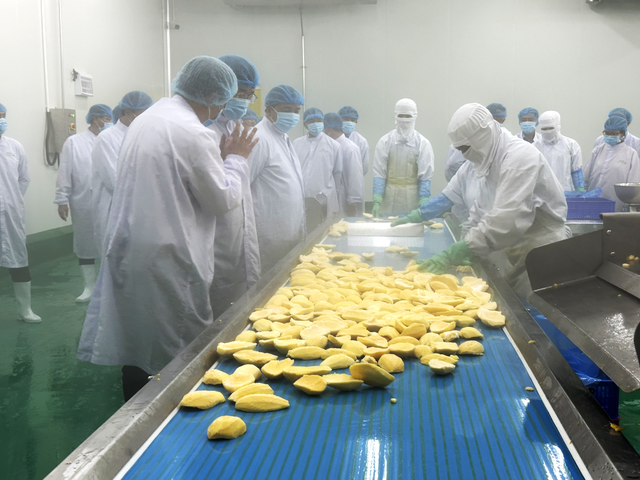
Mango processing for export at Sa Dec Industrial Park in Dong Thap Province, southern Vietnam. Photo: Dang Tuyet / Tuoi Tre
Aiming higher in 2026
For 2026, the Ministry of Agriculture and Environment has set an ambitious target of $73-74 billion in total agro-forestry-fishery exports, a goal that would deliver greater gains for farmers.
To achieve it, the ministry plans to strengthen market linkages, boost processing and domestic consumption, and address oversupply and price slumps that harm producers.
Measures include improved forecasting, timely support for peak harvests, expanded supermarket distribution, and new market openings in the Middle East and Africa.
Vinafruit’s Nguyen believes fruit and vegetable exports of $9-10 billion in 2026 are well within reach.
China will remain the core market, with Vietnam increasingly adept at meeting its standards.
Newly signed protocols for fresh jackfruit exports alone could double annual export value from about $200 million.
The seafood outlook, however, remains uncertain.
Hang warned that 2026 could be volatile due to unpredictable U.S. tariffs and technical barriers, intensifying competition in markets such as the EU, China, ASEAN, and the Middle East.
Also, the IUU yellow card remains a critical bottleneck.
To sustain double-digit growth, Vietnam must defend its market share in the U.S., while continuing efforts to have the EU’s yellow card lifted, she said.
6 proposals to reach $10 billion in fruit and vegetable exports
Nguyen Thanh Binh, chairman of the Vietnam Fruit and Vegetable Association, outlined six priorities to help the sector hit $10 billion, four years ahead of the national roadmap.
– Improve quality and food safety, with stronger guidance, inspections, and enforcement to build compliance across the supply chain.
– Complete a modern, globally connected traceability system to protect producers, consumers, and exporters.
– Reform inspection, testing and certification systems to ensure fast customs clearance and safeguard Vietnam’s export reputation.
– Enhance branding and promotion of Vietnamese fruits and vegetables at home and abroad.
– Intensify trade promotion and increase frequency, formats, geographic reach, and funding.
– Establish state-backed R&D funds to support new technologies in breeding, post-harvest handling and preservation.
VASEP deputy secretary general To Thi Tuong Lan said that Vietnamese seafood companies have shown exceptional flexibility.
While competitors such as India rely heavily on the U.S. market, Vietnamese exporters diversified quickly into Japan, Europe, and other countries.
Besides, deep processing further boosted value, with processed shrimp exports to Japan alone jumping nearly 60 percent.
However, the sector is bracing for pressure in early 2026, when the U.S. issues final rulings on anti-dumping duties for pangasius and shrimp, potentially as high as 35 percent.
Tieu Bac - Chi Tue - Bao Ngoc / Tuoi Tre News
Link nội dung: https://news.tuoitre.vn/vietnams-agro-forestry-fishery-exports-turn-tables-hit-70bn-in-2025-103260104155210793.htm