
Vietnam’s Factory A32 boosts self-reliance in fighter jet maintenance
Vietnam’s military aviation overhaul capability is steadily moving toward greater self-reliance as Factory A32 expands its capacity to produce an increasing share of spare parts for fighter jet maintenance, reducing dependence on imported components that are often expensive, scarce, and vulnerable to global supply disruptions.
Located in Da Nang City, central Vietnam, Factory A32, under the Air Defense-Air Force Service of the Vietnam People’s Army, has developed over six decades into one of the country’s key military aviation maintenance facilities.
The factory’s progress has been described by its leadership as a major breakthrough in strengthening domestic capability, helping address long-standing challenges in maintaining and extending the service life of combat aircraft such as the MiG-21, Su-22, Su-27, and Su-30MK2.
‘Factory within factory’ drives in-house aircraft parts manufacturing
Inside A32, workshop 10 stands out as a highly automated production hub where many components once exclusively imported are now manufactured in-house.
According to Captain Phan Dac Thinh, a technical assistant at the workshop, the entire production system has been automated to meet the strict precision requirements of military aviation maintenance, allowing the unit to produce a wide range of technical materials and spare parts.
From the outside, workshop 10 resembles a modern industrial facility, with precision machinery continuously producing, sorting, and testing mechanical components before they are delivered to aircraft maintenance lines.
The workshop operates under a ‘factory within a factory’ model and is part of an investment program aimed at strengthening self-sufficiency in aviation materials and components, using automated and computer numerical control-based production lines to ensure accuracy and consistency.
A32 Director Colonel Pham Ba Nguyen said the development of independent research and manufacturing capacity for aircraft-grade components is one of the factory’s most significant achievements, particularly in reducing reliance on imported spare parts that were previously essential for maintenance and life extension of combat aircraft.
From imports to domestic production via reverse engineering
For many years, A32 relied heavily on imported parts delivered as complete assemblies. However, global political and logistical disruptions have at times made supply chains unstable, leading to aircraft being grounded for extended periods due to missing components.
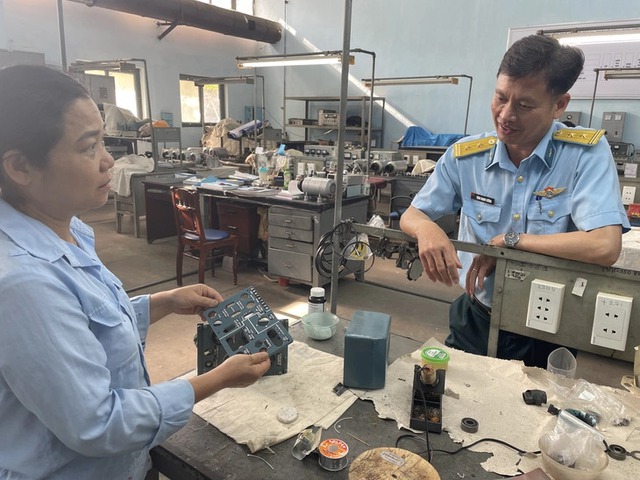
An exchange between an officer (R) and a technician at a workshop repairing fighter jet spare parts at Factory A32 in Da Nang City, central Vietnam. Photo: B.D. / Tuoi Tre
These delays not only affected operational readiness but also increased procurement costs due to strict intellectual property protections and monopoly pricing mechanisms.
The factory initially focused on producing the smallest and simplest components, including electrical connectors and piping joints.
Even these basic items required reverse engineering, as original blueprints, specifications, and material inputs were not always available.
Technicians often dismantled parts from decommissioned aircraft to study, measure, and recreate technical drawings before attempting production.
According to Senior Lieutenant Colonel Trinh Van Minh, deputy head of A32’s technical department, aircraft materials are divided into metal and non-metal categories, with domestic production now covering 30-40 percent of metal components alongside a significant share of non-metal materials.
He said this progress reflects accumulated experience, overseas training, and continuous in-house research by engineers and officers working to reduce dependence on external suppliers.
Expanding aircraft components, avionics capabilities
Senior Lieutenant Colonel Nguyen Van Dung, head of the production team at workshop 1, recalled a training trip to Belarus where Vietnamese officers observed Su-27 fighter maintenance operations.
He said observing foreign technicians directly disassembling aircraft components provided critical insight that was later applied at A32 to replicate previously outsourced procedures.
At workshop 10, Captain Phan Dac Thinh introduced a wide range of products now produced domestically, including rubber molding tools, grounding wires, hose clamps, bolts, load-bearing fasteners, and weapon mounting structures used in fighter jets.
Each product follows a strict multi-stage process, from order reception and sample analysis to design work, machining on equipment such as lathes, milling and grinding machines, surface treatment including anti-corrosion plating, and final quality inspection before mass production.
The factory currently turned out thousands of components, meeting about 98 percent of demand for rubber and Teflon spacers used in repair work.
It also manufactures more than 750 types of metal components each year, covering over 40 percent of replacement parts for aircraft such as the Su-22, Su-27, and Su-30MK2.
In addition, A32 has developed hundreds of electronic panel types with two to 16 layers and mastered all FPGA configuration software as well as about 80 percent of ROM and flash control software used in Su-30 aircraft circuit boards.
Colonel Nguyen said the factory also churns out modules, transformers, and radar communication devices for maintenance and assembly work, while continuing to expand projects aimed at replacing imported electronic boards and control systems.
These developments reflect a broader effort to build a more independent defense maintenance ecosystem, starting from what officials describe as ‘the smallest screw’ and gradually extending to complex aircraft systems.
Vinh Tho - Thai Ba Dung / Tuoi Tre News
Link nội dung: https://news.tuoitre.vn/vietnams-factory-a32-boosts-self-reliance-in-fighter-jet-maintenance-103260417135923441.htm