
Vietnam’s Mekong Delta tourism seeks ways to break from the sameness and draw tourists back
Representatives of major tourism companies have offered ideas to make tourism in Vietnam’s Mekong Delta less repetitive and give visitors more reasons to return.
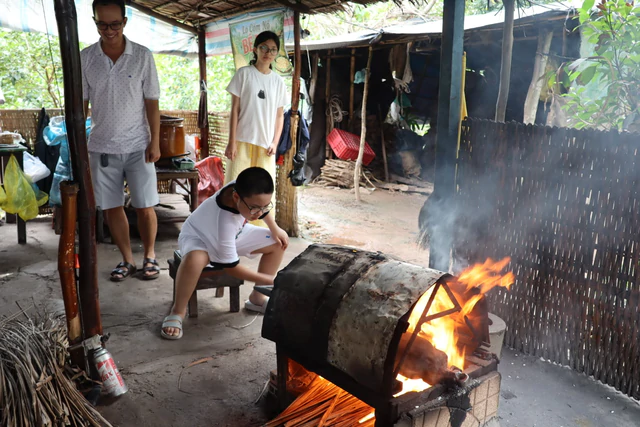
Visitors try making puffed rice during a community tourism experience on Son Islet in Can Tho City, Mekong Delta, southern Vietnam. The activity is considered a distinctive and enjoyable experience unique to the area. Photo: Ca Linh
For years, many tourists have visited the Mekong Delta only once, as tourism products across the region have been largely similar, with little to distinguish one locality from another.
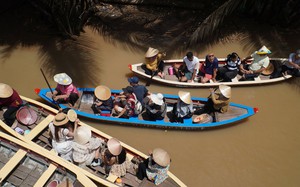
In one province after another, visitors encounter the same activities: rowing boats, touring fruit orchards, picking fruit, catching fish by draining ponds, and listening to folk music in similar settings.
Each locality needs its own story
Ta Thi Tu Uyen, deputy director of the business development division at Vietravel, said Ho Chi Minh City and the Mekong Delta provinces have established numerous cooperation programs, tour routes and tourism promotion activities.
However, tourism products across localities remain similar.
Many tours focus mainly on visiting attractions, taking boat trips, exploring fruit orchards, floating markets and craft villages, and trying local food.
While products are available, they have yet to offer strong enough reasons for visitors to stay longer, spend more and return.
Uyen therefore suggested that future cooperation should shift from linking destinations by administrative boundaries to building a chain of experiences connecting Ho Chi Minh City and the Mekong Delta, rather than developing them as separate destinations.
“For example, instead of selling a traditional Ho Chi Minh City-My Tho or Can Tho tour, we could build a ‘Live like a Mekong local’ journey,” she said.
“Visitors would not just see the sights. They could go to a local market with residents, work in the fields, pick fruit in orchards with local people and experience seasonal produce while learning about specialties that can only be found in each locality,” she added.
“That would create an emotional experience and leave visitors with longer-lasting memories.”
Uyen also said each locality should identify just one or two truly distinctive flagship tourism products, which she described as crucial, and determine what role it can play in the broader Mekong tourism journey.
Uyen suggested the overarching message “Live like a Mekong local,” with each locality telling its own story.
For example, Vinh Long will be the “heart of the Mekong,” Can Tho as “Life along the Hau River,” and Ca Mau with the story of “Legendary U Minh nights.”
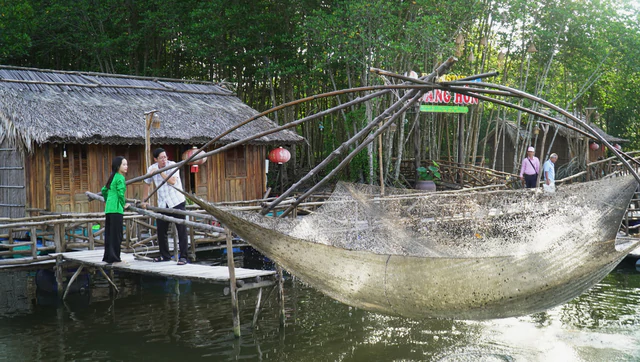
Visitors pull up a fishing net at the Dat Mui eco-tourism site in Ca Mau Province, southern Vietnam. Photo: Thanh Huyen / Tuoi Tre
With this approach, visitors would learn how people live in each locality and have distinctive experiences that help them remember what makes each province unique.
This would prevent duplication while allowing visitors to experience the best of each locality and its culture.
Distinctive products, but common standard
Nguyen Huu Y Yen, chairman of the Members' Council of Saigontourist Travel Service Company, said the region needs to develop strong signature tourism products.
According to him, the Mekong Delta has abundant tourism resources, but they only become valuable when transformed into attractive, distinctive and commercially viable experiences, he said.
“We need products that make visitors immediately think of experiences they can find only in the Mekong when they hear the name Mekong,” Yen said.
He also called for standardized service quality across the Mekong Delta.
Each locality can have its own identity and products, but service quality should meet common standards, particularly in hygiene, safety, service quality, destination information, foreign languages and tour guides.
“In my view, 2026-2030 is the time for tourism cooperation between Ho Chi Minh City and the Mekong Delta to enter a new stage that is more substantive and effective,” he said.
“Ho Chi Minh City should promote its role as a gateway and visitor distribution hub; the Mekong Delta should develop distinctive, high-quality, green and unique experiences; while businesses should connect with markets, commercialize products and bring visitors to destinations,” he added.
“The ultimate goal is not simply to bring more tourists to the Mekong Delta, but to make them stay longer, spend more, have better experiences and want to return.”
Ho An Phong, deputy minister of Culture, Sports and Tourism, also said Mekong Delta tourism products need to be promoted internationally in ways that highlight their differences and reduce duplication.
This requires new approaches and stronger coordination, he said.
“Without coordination, differentiation and unique experiences, visitors may feel they have seen everything after visiting just one place,” Phong stated.
“But the more they explore, the more differences they discover. That is the unity in diversity of this southern land.”
- REFERENCE MORE
- REFERENCE MORE
- REFERENCE MORE
Chi Quoc - Dong Nguyen / Tuoi Tre News