
Vietnam's platform workers earn decent incomes but face long hours, social safety net gaps: World Bank
At a joint workshop with the World Bank (WB), Vietnamese officials highlighted that despite average earnings reaching nearly VND10 million (US$385) per month, overworking and low social security participation remain critical challenges for the growing gig economy.
The findings were presented by Nguyen Thi Nga, a social security specialist at the World Bank, at the workshop jointly organized by Vietnam Social Security and the global credit institution in Hanoi on Tuesday to discuss employment and social security for platform workers in Vietnam.
Platform workers are gig workers whose work is mediated by digital platforms, which can be categorized as web-based or location-based.
According to a 2026 survey of nearly 4,900 workers on four digital platforms in 34 provinces and cities, 94 percent of respondents said platform work was their main job, while 80 percent had been working through platforms for at least one year.
Job flexibility was the main reason workers chose platform work, followed by the opportunity to earn income, Nga said.
Average net monthly earnings ranged from VND7.4 million ($285) to VND9.7 million ($374), depending on the platform.
However, 78 percent of those surveyed had not participated in social insurance during the six months preceding the survey, highlighting a significant gap in social protection for platform workers, according to the World Bank.
The survey also found that platform workers were interested in social insurance packages that could provide greater protection against risks in their lives and work.
The World Bank said the findings provide important data for authorities to study and develop an appropriate roadmap for expanding social insurance coverage.

Tran Dinh Lieu, deputy director of Vietnam Social Security, speaks at the workshop in Hanoi on September 22, 2026, which focused on employment and social security for platform workers in Vietnam. Photo: Ha Quan / Tuoi Tre
A representative of the Ministry of Home Affairs' Department of Wages and Social Insurance said voluntary social insurance participants currently account for only around 5.5 percent of the labor force, or about 2.63 million people.
In the long term, authorities will propose more attractive wage and social insurance policies to encourage greater participation in the social security system, the representative said.
Authorities also need further opinions, feedback and international experience to clarify the employment relationship between platform workers and digital platform providers, as well as study regulations on contribution levels, payment methods and legal responsibilities.
Meanwhile, Ho Thi Kim Ngan, deputy head of the Vietnam General Confederation of Labor's Industrial Relations Department, cited a recent rapid survey showing that Ho Chi Minh City has around 400,000 technology-based ride-hailing and delivery drivers.
More than 46 percent of those surveyed said they worked eight to 10 hours a day, while around 35 percent regularly worked more than 10 hours a day, Ngan said.
Therefore, even a monthly income of VND15 million ($576) does not necessarily mean high earnings given the long hours required to achieve it, she emphasized.
Ngan recommended introducing more policies to encourage workers to participate in compulsory social insurance in the long term, with the goal of ensuring that everyone who earns an income, not only platform workers, has access to social insurance.
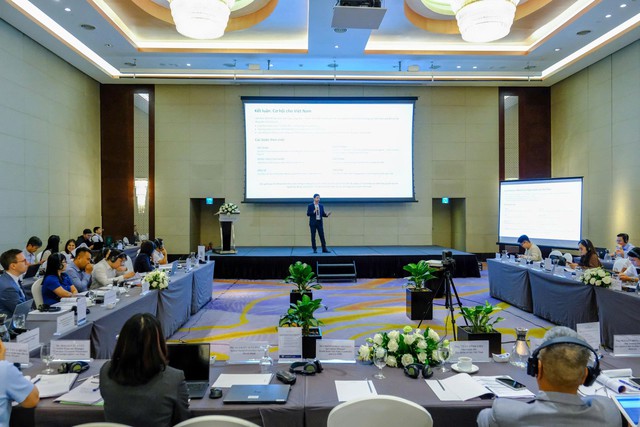
An overview of the workshop in Hanoi on September 22, 2026, which focused on employment and social security for platform workers in Vietnam. Photo: Ha Quan / Tuoi Tre
Tran Dinh Lieu, deputy director of Vietnam Social Security, said social insurance coverage had continued to expand, with more than 22.4 million people participating in the system in the first eight months of 2026, equivalent to nearly 47 percent of the labor force.
However, some contract-based and part-time workers with stable incomes still do not participate in social insurance, Lieu said.
Some workers may also shift to jobs in transportation, delivery, sales, brokerage or digital platforms, either for short periods or on a part-time basis, according to Lieu.
Many countries around the world are adopting different approaches to expanding social protection for workers in new employment models.
Vietnam therefore needs to clearly assess the reality of platform-based work and the situation of platform workers, as well as other forms of work that do not involve traditional employment contracts, Lieu said.
A similar statement was made at a recent seminar in Ho Chi Minh City on social security for ride-hailing drivers, which highlighted the long working hours, relatively low incomes and limited social protection faced by many drivers.
The seminar noted that many drivers work more than 10 hours a day, with some working up to 17 hours, while their monthly income can be relatively modest compared with the time they spend working.
A quick survey of 141 drivers working on Grab, Be and Xanh SM found that 93.6 percent of respondents said ride-hailing was their main job, underscoring the need for stronger social protection for workers in the gig economy.



Vinh Tho - Ha Quan / Tuoi Tre News