
Vietnam’s small businesses squeezed by green transition
Small and medium-sized enterprises (SMEs) in Vietnam are coming under increasing pressure as the country accelerates its green transition, with rising investment costs and limited financial and technical resources making it difficult for many firms to meet increasingly stringent environmental requirements.
On Thursday, the Ho Chi Minh City Export Processing and Industrial Zones Authority (HEPZA) held a workshop titled "Raising Legal Awareness on Environmental Protection and Financial Solutions for Enterprises in Ho Chi Minh City's Industrial Zones."
There, small businesses voiced a pressing concern: they want to go green, but with limited capital and resources, they do not know where to begin.
Caught between capital and resource constraints
A representative from a small Ho Chi Minh City business said she had previously worked at a multinational corporation (MNC) where green design standards had been in place for more than a decade - products were designed to use only as much material as necessary, avoiding over-specification, thereby cutting raw material use and limiting waste across the product's life cycle.
But when she tried to apply a similar model at her current company, she ran into considerable obstacles.
The biggest one is upfront investment cost: designing eco-friendly packaging or switching to new materials raises production costs in the short term, putting small businesses at a competitive disadvantage against companies that have yet to make the green transition.
On top of that, small businesses lack the communication budgets that MNCs have.
As a result, even when a company has invested in green production, consumers often cannot tell the difference, meaning those environmental efforts fail to translate into a real competitive edge in the market.
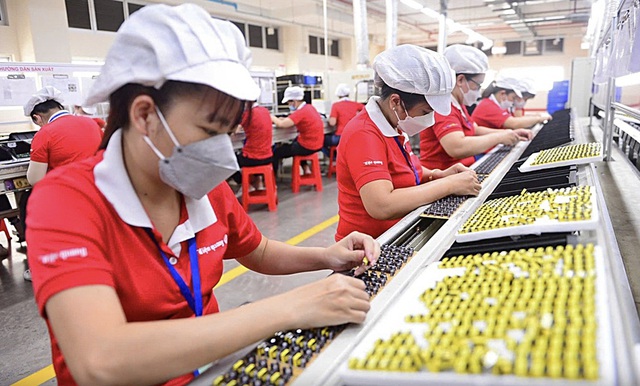
Green manufacturing is key to helping Ho Chi Minh City retain existing investors and attract high-quality FDI. Pictured: electrical equipment production in Ho Chi Minh City. Photo: QUANG DINH / Tuoi Tre
A way forward: design and finance
Addressing these concerns, Nguyen Thi Thu Ha, deputy director of the Vietnam Recycling Institute (VRI) under the Vietnam Waste Recycling Association (VWRA), said that once legal regulations take full effect, businesses will no longer have the choice of whether to comply.
In other words, they will be legally required to.
From another perspective, Ha noted that getting things right at the design stage can actually cut costs.
She pointed to two types of water bottles: removing the plastic label and printing information directly onto the bottle reduces material use, cuts printing costs, makes recycling easier, and lowers the cost of meeting recycling obligations under Extended Producer Responsibility (EPR) regulations.
"Green design doesn't just serve environmental protection, it also helps businesses save costs in the long run, Ha said.

“Companies that comply well with regulations will gain an edge too, as customers and supply chain partners pay increasing attention to environmental criteria.”
From a financial standpoint, Vu Thi Hong Nhung, a representative of the Joint Stock Commercial Bank for Foreign Trade of Vietnam (Vietcombank), said the bank has been developing a range of green financial products to support businesses through their transition.
According to her, the biggest obstacle for SMEs is a lack of collateral.
However, for businesses within an foreign direct investment (FDI) enterprise's supply chain, banks can draw on the cash flow and creditworthiness of the anchor company to extend credit, while also reducing collateral requirements, shortening appraisal times, and digitizing processes to make capital easier to access.
Meanwhile, Le Van Thinh, deputy head of HEPZA, said businesses should see EPR as an opportunity to restructure their production models rather than simply as an obligation.
"We want businesses to shift from a waste-management mindset to a resource-governance mindset. The circular economy doesn't slow growth, it helps create more value from the same amount of resources, or even less," Thinh said.
Nhat Xuan - Kim Thoa / Tuoi Tre News
Link nội dung: https://news.tuoitre.vn/vietnams-small-businesses-squeezed-by-green-transition-10326070319195151.htm