


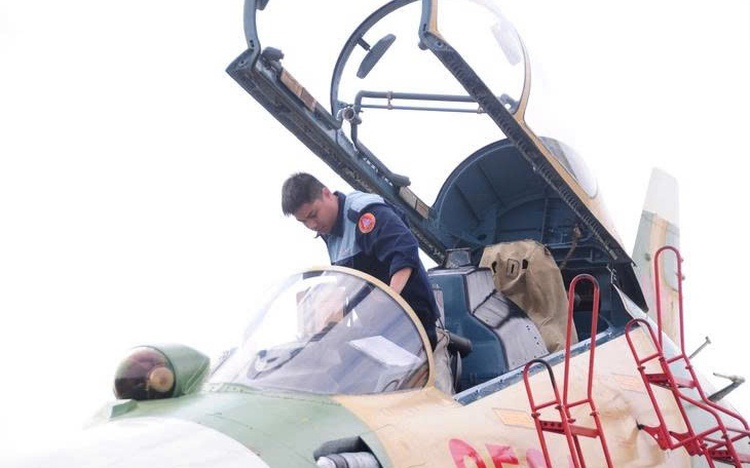
A technician examines a fighter jet at Factory 32 in Da Nang City, central Vietnam. Photo: B.D. / Tuoi Tre
Operating under the Air Defense-Air Force Service of the Vietnam People’s Army, the facility has long relied on close coordination among engineers and technicians, each responsible for specific stages of complex maintenance to ensure aircraft are safely returned to service.
Built on six decades of hands-on experience, the factory is now increasingly supported by doctoral-level engineers whose research is helping drive structured innovation and the domestic production of aviation materials.
Doctoral engineers drive applied aerospace research
A32 has recently reinforced its technical capacity with the addition of two doctoral-level engineers transferred from the Vietnam People’s Air Force, a step forward in building in-house aerospace research capabilities.
One of them is Dr. Trinh Van Minh, a 40-year-old aerospace engineer trained in Russia.
He has contributed to efforts to localize aviation materials used in fighter jet maintenance, including rubber sealing components for oxygen systems on combat aircraft.
These components are now produced domestically at A32 and integrated into maintenance cycles, helping extend service life while reducing reliance on imported supplies.
Minh studied aircraft engineering at Bauman Moscow State Technical University before completing his doctoral research at Moscow Aviation Institute.
He said his training helped him build technical networks and access knowledge later applied to aviation maintenance work in Vietnam.
He joined A32 in 2018 as the factory’s first doctoral-level officer, indicating a shift toward integrating structured research into a system previously driven largely by experience-based maintenance.
Factory director Colonel Pham Ba Nguyen said A32 has achieved a certain level of self-reliance in aviation materials, but earlier progress was largely based on practical learning among technicians.
As aircraft systems grow more complex, he said, scientific research is increasingly essential to reduce dependence on imported spare parts.
Another engineer, Hoang Vu Tan, also trained in Russia in aircraft engine systems, has joined the factory.
He said his work focuses on translating technical documentation, particularly in Russian, into practical applications for Vietnam’s aviation maintenance system, stressing that technological autonomy is vital to national defense capability.
From experience-based maintenance to applied innovation
Alongside its expanding research capacity, A32 continues to rely on a long-established workforce of technicians with decades of experience in fighter aircraft maintenance.
Much of the factory’s technical knowledge has been accumulated through hands-on work, repetition, and peer training.
Increasingly, however, technicians and engineers are working together to turn maintenance challenges into applied research projects.
Several initiatives led by Dr. Minh and colleagues have already been implemented, including the domestic production of oxygen system rubber components for fighter jets and ground-based aviation equipment used for testing and technical evaluation.
These developments reflect a gradual shift from routine repair work toward a more structured innovation model, in which maintenance problems are converted into engineering solutions that can be produced and reused within the system.
Factory leaders said this integration is crucial as Vietnam seeks to reduce reliance on imported aviation materials, which remain costly and vulnerable to supply disruptions.
At A32, long-established technical expertise and emerging scientific research are increasingly intertwined, forming a hybrid system in which engineers and technicians work side by side to advance Vietnam’s goal of greater autonomy in aircraft maintenance and aviation technology.
Female technicians take on critical roles
Alongside engineers and researchers, A32 relies on highly skilled technicians performing some of the most demanding tasks in fighter jet maintenance, including experienced female specialists working directly on aircraft systems.
One of them is Ta Thi Hue, a veteran technician with 33 years at the factory.
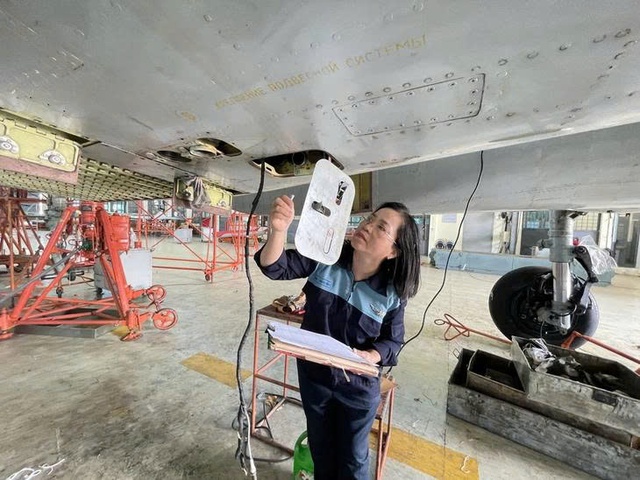
Hoang Thi Thanh Binh, a senior technician at Factory A32 in Da Nang City, central Vietnam, inspects electrical connections on a fighter jet. Photo: B.D. / Tuoi Tre
She works on electrical systems, cockpit controls, lighting systems, and air conditioning units on fighter jets such as the Su-27.
Despite multiple leadership changes, Hue has remained in the same workshop position, reflecting deep specialization and long-term commitment.
She said aircraft maintenance requires absolute precision, as even minor errors can compromise flight safety.
Coming from a family with a tradition in aircraft maintenance, she developed an early interest in mechanical and electrical systems that evolved into a lifelong career.
Hue described her work as repetitive but highly demanding, requiring patience and meticulous attention to detail.
One recent task involved restoring an air conditioning unit for a fighter jet, a component she said is worth around VND1 billion (US$38,000), and extremely difficult to replace.
Another senior technician, Hoang Thi Thanh Binh, works in the fault diagnosis team at Workshop 1, where she inspects electrical systems in dismantled aircraft.
She compared a fighter jet’s wiring system to a circulatory network, in which thousands of interconnected circuits must function correctly for the aircraft to operate.
Even a single faulty connection can disrupt the entire system.
Her work involves inspecting wiring points using flashlights and diagnostic tools, including in hard-to-reach areas.
All findings are recorded and handed over to repair teams at the factory for further action.









Max: 1500 characters
There are no comments yet. Be the first to comment.