


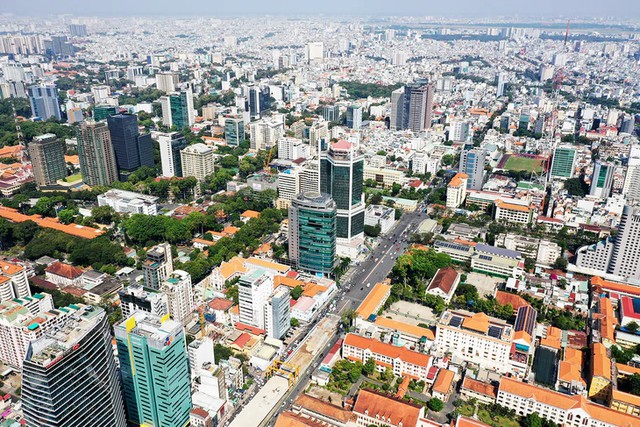
Many streets in downtown Ho Chi Minh City have seen sharp increases in adjusted land prices compared with the previous land price list. Photo: Tu Trung / Tuoi Tre
A key point is that the right to own housing and the right to use residential land are governed by land law and do not change Vietnam’s constitutional principle that land belongs to the entire people and is managed by the State.
Clearly defining legal subjects and their rights
Under the 2023 Housing Law, overseas Vietnamese, as defined by nationality law, are among those eligible to own housing in Vietnam.
Those permitted to enter the country may own homes associated with residential land-use rights in accordance with land legislation.
The 2026 draft draws clearer distinctions among Vietnamese citizens, people of Vietnamese origin residing overseas, and foreign organizations and individuals, with different rights and conditions applying to each group.
Notably, a Vietnamese citizen who also holds foreign nationality will be treated as a Vietnamese citizen when buying or hire-purchasing a home in Vietnam if they use their Vietnamese nationality for the transaction.
The provision is intended to make it clearer which legal status applies when determining a person’s housing rights and eligibility.
For people of Vietnamese origin residing overseas, the draft provides that those permitted to enter Vietnam may own housing associated with residential land-use rights under land law.
However, this does not mean they own the land itself.
Land-use rights are not land ownership
The distinction is reinforced by Resolution 21-NQ/TW, which states that land is a special national resource and belongs to the entire people, with the State acting as the representative owner and exercising unified management.
The resolution also stresses that land must not be privatized.
It defines land-use rights as a special type of asset and commodity, but not as ownership rights. Land-use rights and assets attached to land are protected by law.
Therefore, a person of Vietnamese origin residing overseas may legally own a house and hold residential land-use rights without owning the land itself.
Such land-use rights are recognized and protected within the scope, duration, and conditions prescribed by law.
Resolution 21-NQ/TW also states that foreigners are not allowed to receive transfers of land-use rights in any form, except for people of Vietnamese origin residing overseas where permitted by law.
The key issue in finalizing the amended Housing Law, therefore, is not simply whether to expand or restrict housing rights for overseas Vietnamese, but to clearly define who qualifies, what rights they hold, and under what conditions those rights can be exercised.
Rules on documents proving legal status and eligibility for home ownership will also need to be clear and workable so that people whose rights are recognized by law can exercise them in practice.
The central legal boundary remains unchanged: home ownership must be distinguished from residential land-use rights, and land-use rights must not be confused with ownership of land itself.








Max: 1500 characters
There are no comments yet. Be the first to comment.