


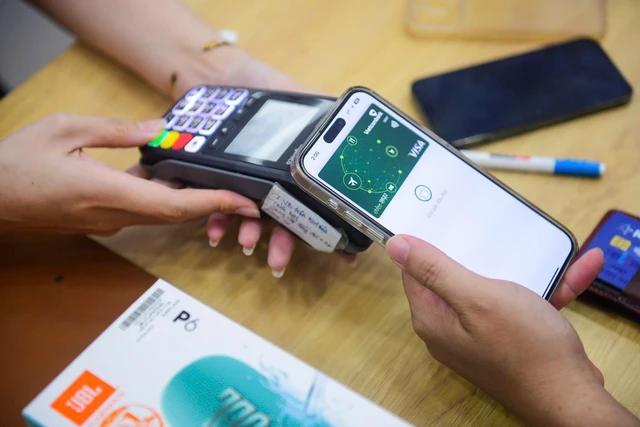
A customer uses Apple Pay to make a payment with a smartphone at a retail checkout. Photo: Quang Dinh / Tuoi Tre
The study, based on a survey of 1,000 consumers in Vietnam, found that the country stands out in a region where consumer confidence remains uneven, positioning Vietnam among Asia Pacific's most future-ready markets as digital commerce continues to evolve.
Visa said improving consumer sentiment is shaping how Vietnamese consumers shop, pay, and interact with new technologies, reflecting broader progress under the country's digitalization agenda.
Vietnam showed some of the strongest interest in AI-assisted shopping in the region, with 57 percent of respondents saying they were open to using AI agents for online shopping, compared with the Asia Pacific average of 50 percent.
The study said AI tools are increasingly viewed as a way to simplify product searches, comparisons, and purchases.
At the same time, consumers continue to cite concerns about data privacy, accuracy, and unauthorized payments.
Vietnam also ranked among regional leaders in cross-border payment readiness.
The survey found that 56 percent of Vietnamese consumers owned multi-currency payment cards and 34 percent actively used them, compared with Asia Pacific averages of 52 percent and 28 percent, respectively.
The findings come as payment habits across the region continue to shift.
Visa said credit cards have overtaken cash as the preferred payment method for overseas travel in Asia Pacific, reflecting increasing demand for payment options that offer broader acceptance and consumer protections.
Confidence is improving across the region, led by markets including India, Vietnam, and China, although spending recovery remains selective rather than broad-based.
Consumers continue to prioritize major purchases in categories such as travel, healthcare, and electronics.
The report also found that younger consumers remain more optimistic than older generations despite concerns about job security and artificial intelligence.
For Generation Z, born between 1997 and 2007, saving for travel has become the top financial goal, supporting expectations for future cross-border spending.
Visa said credit cards are regaining relevance across Asia Pacific, supported by demand for security, control, and rewards.
Cashback remains the most widely valued card benefit, while markets such as Singapore and Hong Kong show stronger demand for travel rewards and airline miles.
Mobile payments continue to dominate consumer spending across the region, with QR-code payments leading adoption in markets including China, Thailand, and Indonesia.
Cards remain the primary payment method in Australia, New Zealand, Japan, and South Korea, underscoring the role of card credentials within digital wallets.


The study also found that e-commerce has become nearly universal across Asia Pacific and that consumers are increasingly open to AI-powered shopping experiences, particularly in China, India, and Vietnam.
Trust, including confidence in privacy, accuracy, and protection against unauthorized payments, remains a key factor influencing adoption.
"Vietnam's strong consumer confidence reflects the country's broader economic momentum and the rapid maturation of its digital economy," said Dung Dang, Visa's country manager for Vietnam and Laos.
"This is translating into clear behavioral shifts, from growing openness to AI-assisted shopping to stronger readiness for cross-border digital payments," she said.
Visa said the findings align with themes being discussed at Digital Finance Day 2026, an initiative organized by Tuoi Tre (Youth) newspaper under the direction of the State Bank of Vietnam to promote secure, innovative, and inclusive digital payments.
Speaking at a press conference announcing the event, Kelvin Utomo, Visa's head of products and solutions for Vietnam, Cambodia, and Laos, said the company would focus on expanding QR payment infrastructure, strengthening AI readiness, and helping businesses capture opportunities from digital payments.
Visa said its Consumer 360 findings suggest that growing confidence in digital tools and trusted payment infrastructure is enabling Vietnamese consumers to adopt new technologies and participate more actively in increasingly connected global commerce.









Max: 1500 characters
There are no comments yet. Be the first to comment.