


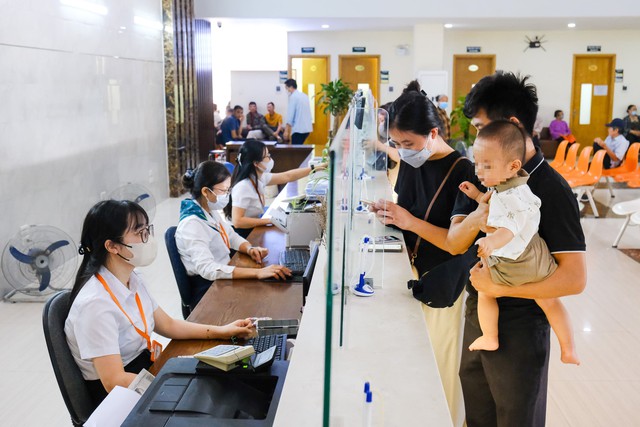
Residents register for health insurance-covered medical examination and treatment at a hospital in Bac Ninh Province, northern Vietnam. Photo: Ha Quan / Tuoi Tre
The roadmap, aligned with the Politburo’s Resolution 72-NQ/TW issued in September 2025, sets out the phased implementation of the policy.
2026–2027: Expanding health benefits, insurance coverage
During this phase, the Ministry of Health will study the costs and effectiveness of selected medical services, conduct impact assessments, and prepare policy reports before, during, and after implementing the plan.
From 2026, citizens will be entitled to at least one free annual health check-up or screening, based on priority groups and the phased schedule.
Routine check-ups, free screening programs, student and occupational health examinations, and insurance-covered treatments will be coordinated to provide free medical examination while establishing electronic health records for all citizens.
Priority groups will include health insurance participants from near-poor households and elderly citizens aged 75 and above who receive social pension allowances.
These groups will receive 100 percent coverage of medical costs within the scope of health insurance benefits, alongside increased payment rates for medicines, technical services, and other medical procedures.
Health insurance contributions are set to rise to around 5.1 percent from 2027, with state support provided for social policy beneficiaries.
2028–2030: Cutting out-of-pocket costs, expanding coverage
During this phase, the policy aims to further increase health insurance payment rates and coverage for medicines, medical equipment, and technical services, while piloting cost-effective screening programs for two to three diseases.
Health insurance funds will also begin covering preventive care, with overall insurance coverage expected to exceed 95 percent of the population.
Health insurance contributions are set to rise to 5.4 percent from 2030, while pilot programs for supplementary insurance and diversified long-term care packages will be launched.
After 2030: Achieving universal health insurance coverage
The ministry plans to expand cost-effective screenings to three to five diseases and provide hospital fee exemptions for all citizens within the basic service package, with coverage gradually extended based on available resources.
Health insurance contributions are expected to reach six percent from 2032, alongside the completion of the primary healthcare network and a smart, multi-tiered health insurance payment system with multiple benefit packages.
Toward sustainable, equitable, efficient healthcare system
The overarching goal of the policy is to gradually expand benefits while improving the quality and efficiency of healthcare services nationwide.
Reducing financial burdens will be a key priority, particularly for the poor, near-poor households, social policy beneficiaries, middle-income groups, and other vulnerable populations, helping to prevent illness-induced poverty and ensure that ‘no one is left behind.’
The health system will focus on ensuring equitable access to services while strengthening disease prevention and control, thereby reducing reliance on costly late-stage treatment.
Sustainable financing mechanisms will be developed to support these objectives and help realize the goals set out in Resolution 72.
To achieve these goals, the health sector will prioritize strengthening system-wide capacity, improving service quality, reinforcing commune-level health stations, and narrowing disparities in access and service quality across regions and levels of the country’s healthcare system.
Private healthcare providers will also be encouraged to play a greater role in service delivery.
At the same time, digital transformation will be accelerated, from integrating medical data to building lifelong electronic health records for every citizen, supporting proactive and continuous health management.
These reforms will lay the groundwork for institutional improvements and enhance the overall efficiency and sustainability of the national healthcare system.









Max: 1500 characters
There are no comments yet. Be the first to comment.