


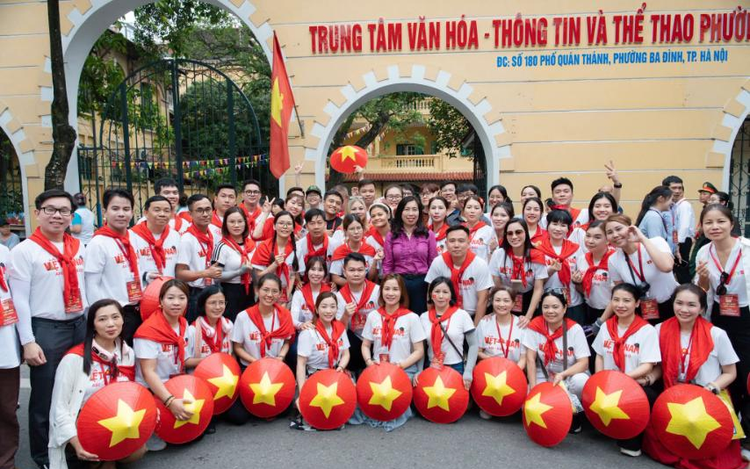
This file photo shows Deputy Minister of Foreign Affairs Le Thi Thu Hang meeting with overseas Vietnamese entrepreneurs, intellectuals, and students. Photo: Ministry of Foreign Affairs
The initiative was highlighted at a seminar on developing networks of overseas Vietnamese experts in strategic technologies, held in Hanoi on Sunday by the State Committee for Overseas Vietnamese Affairs under the Ministry of Foreign Affairs, according to the Vietnam News Agency.
Speaking at the event, Deputy Minister of Foreign Affairs Le Thi Thu Hang said the newly issued Politburo Resolution No. 23-NQ/TW on overseas Vietnamese affairs marks a significant change in the country's thinking.
Under the resolution, overseas Vietnamese are recognized not only as an inseparable part of the Vietnamese nation but also as a strategic resource that can help strengthen the country's overall capacity, serve as a bridge between Vietnam and the world, and participate directly in national development, integration, and defense.
The resolution also shifts the government's role from one focused on outreach, gathering, and supporting overseas Vietnamese to one centered on creating mechanisms and an enabling environment for them to make deeper contributions to the country's development.
Government agencies are tasked with creating the space, conditions, and opportunities for overseas Vietnamese to participate in Vietnam's development, integration, and national defense efforts from an early stage, Deputy Minister Hang said.
She stressed the need to better harness the intellectual resources of the overseas Vietnamese community, particularly in science, technology, innovation, and strategic industries.
Vietnam's overseas community currently numbers about 6.5 million people living in more than 130 countries and territories, including roughly 650,000 university graduates or higher.
In recent years, nearly 2,000 experts have joined various overseas Vietnamese professional networks. Five innovation and expert networks have also been established in strategic technology sectors, including artificial intelligence, semiconductors, quantum technology, cybersecurity, aviation, aerospace, and unmanned aerial vehicles. These networks are connected with around 50 overseas Vietnamese professional associations worldwide.
Despite these developments, Hang said the country's overseas intellectual resources have yet to be fully utilized because of insufficient opportunities and an inadequate environment for experts to contribute.
She called on scientists and experts to assess the current performance of overseas Vietnamese professional networks, identify successful and innovative practices, examine existing obstacles and their causes, draw lessons from experience, and propose recommendations.
Hang also insisted on improving links between overseas expertise and domestic demand. Although many overseas professional associations have established connections with ministries, universities, research institutes, and local authorities, she said those partnerships have yet to achieve the desired results, underscoring the need for better matching between supply and demand.
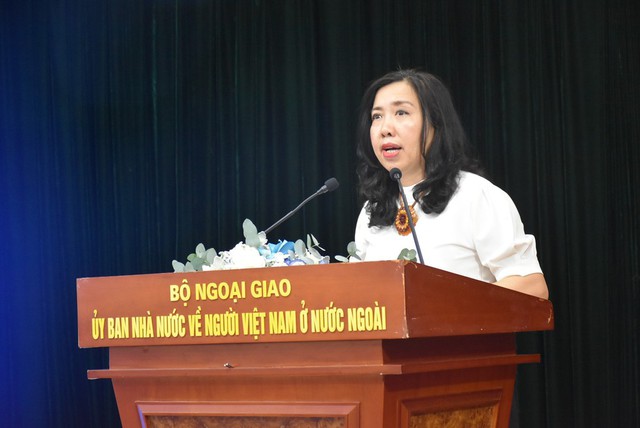
Deputy Minister of Foreign Affairs Le Thi Thu Hang speaks at a seminar on developing networks of overseas Vietnamese experts in strategic technologies held in Hanoi on August 9, 2026. Photo: Vietnam News Agency
She proposed closer coordination between the Ministry of Foreign Affairs, other ministries, local governments, Vietnamese representative missions abroad, research institutes, universities, and professional associations to avoid duplication and strengthen overall effectiveness.
Another priority, she said, is the development of a digital platform that connects overseas Vietnamese experts with domestic needs.
Vietnam is currently building a database on overseas Vietnamese, Hang said, adding that an initial database focusing specifically on experts and intellectuals could be developed first while authorities study the platform's structure, governance model, and operating mechanism.
Participants at the seminar agreed that the overseas Vietnamese community represents a strategic national resource and welcomed the new policy direction under Resolution No. 23-NQ/TW, which emphasizes partnership and institution-building rather than traditional mobilization efforts.
They noted that innovation and expert networks have already emerged in many countries, particularly in key sectors such as artificial intelligence, semiconductors, cybersecurity, and aerospace.
However, the participants also said these networks remain modest compared with the community's overall potential. They cited limited opportunities for meaningful contributions, weak connections between domestic demand and overseas expertise, and administrative barriers as key challenges.
To address these issues, delegates proposed shifting from a policy of encouraging experts to return to Vietnam toward mobilizing Vietnamese knowledge globally through clearly defined national missions and practical problem-solving tasks.
Among the proposals were the creation of a national 'problem bank' containing specific challenges requiring expert input and interoperable digital platforms that directly connect businesses and local authorities with global networks of Vietnamese specialists.
The delegates also spotlighted a proposed 'Technology Train' model, describing it as a practical five-step process: receiving demand, matching expertise, developing projects, implementing solutions, and evaluating and scaling successful outcomes.
In addition, the participants called for improvements to the institutional framework, including appropriate remuneration for work involving data security and intellectual property, as well as a fair and transparent working environment to encourage greater contributions from overseas Vietnamese experts.










Max: 1500 characters
There are no comments yet. Be the first to comment.