


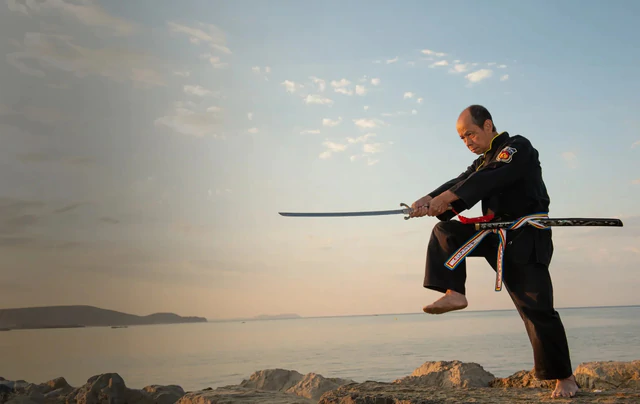
Martial arts master Pham Xuan Tong has helped establish Vietnamese martial arts in Europe. Photo: GKD
In early October 2026, the Italian city of Cervia proudly dubbed itself the world capital of Vietnamese traditional martial arts for a time as it hosted the World Championships & Junior Championships of Vocotruyen (Vietnamese traditional martial arts), which drew around 600 athletes from 45 countries.
From Ho Chi Minh City to France, Italy and beyond
The title of 'world capital of Vietnamese traditional martial arts' was used by Roberta Frisoni, who oversees tourism and sports for Italy’s Emilia-Romagna regional government, in a statement published on the Cervia municipal government’s website.
Among the medalists was Leandro Fusar Poli, an Italian martial artist who has trained in Vietnamese martial arts for 15 years.
According to Cremaonline, he won a silver medal at the Cervia championship for his performance in Qwan Ki Do, a Vietnamese martial arts school founded in France.

Pham Xuan Tong (fourth from left) at an event organized by the Vietnamese Embassy in Romania. Photo: Vietnamese Embassy in Romania
Qwan Ki Do was founded by martial arts master Pham Xuan Tong, who was born in Ninh Binh on July 17, 1947.
He began his martial arts journey in Phu Nhuan, Ho Chi Minh City, where he learned martial arts and traditional medicine from master Chau Quan Ky.
Although based in France, Tong maintains close ties with Vietnam and the Vietnam Traditional Martial Arts Federation. He has also participated in cultural programs organized by Vietnamese embassies in countries including Romania and Italy.
According to a biography published by the Qwan Ki Do school, the master-and-student relationship began on a rainy day when nine-year-old Xuan Tong invited a man riding a bicycle into his home to take shelter from the rain.
From that simple encounter grew a lifelong martial arts legacy.
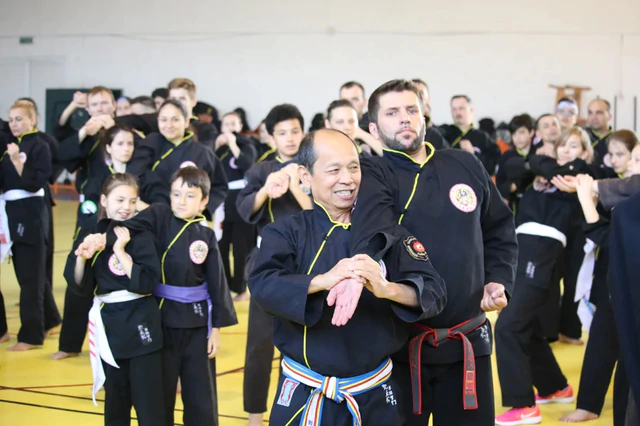
Master Pham Xuan Tong (center) with martial arts students in Europe. Photo: GKD
Tong’s life story was later widely covered by European media.
According to Romania’s Telegraf, he taught martial arts at Don Bosco Technical School in Go Vap from 1964 to 1967 while also competing in matches in Cho Lon. Before founding an international martial arts school, he worked as a student, competitor and instructor.
In 1968, Tong moved to France to continue his studies in physical education and sports.
He brought his martial arts knowledge from Vietnam to his new home and began teaching there. In the early 1970s, he worked with Vietnamese martial arts masters to develop the Viet Vo Dao movement in Europe, serving as its international technical director.
To take Vietnamese martial arts beyond demonstrations, practitioners also needed structured curricula, ranking systems and competition rules.
Tong developed a detailed plan to promote Vietnamese martial arts in France.
In 1981, he officially founded Qwan Ki Do in Toulon, southern France.
The discipline combined Vietnamese and Chinese martial arts techniques he had learned, systematizing them into a new technical system.
Its curriculum includes forms, punches, kicks, elbow strikes, sweeps, throws, joint locks and traditional weapons, offering a diverse training program.
In a 2006 interview with Romania’s Telegraf, Tong explained that he had brought together the techniques passed down by his teachers and continued refining the method.
The newspaper described him as 'a living legend of martial arts' and also noted his work providing physical training for Toulon’s municipal police.
From dojos to universities
Qwan Ki Do grew through the support of local practitioners. In Italy, martial arts master Roberto Vismara met Tong in 1976 and became one of his earliest students.
When the discipline was formally established in 1981, Vismara took the lead in promoting it across Italy.
In 1994, Milan hosted the first Qwan Ki Do World Championship. Classes, training seminars and competitions helped pass on the Vietnamese master's teachings to new generations.
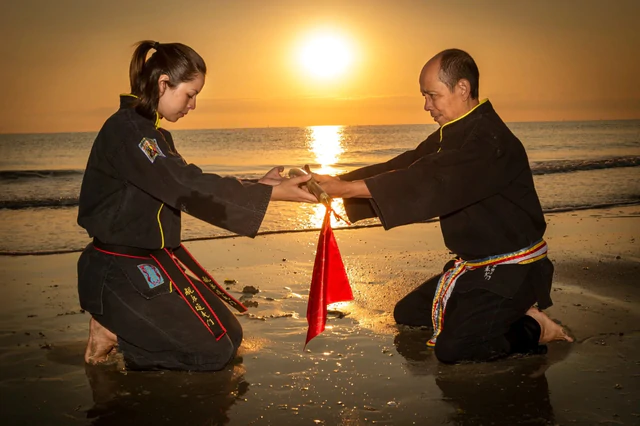
Master Pham Xuan Tong teaching a student. Photo: GKD
The Italian master helped Qwan Ki Do expand beyond France, spreading the discipline to Italy before it gradually gained popularity across Central Europe.
Romania was another country where Qwan Ki Do took root.
According to Alexandru Ioan Cuza University of Iași, the country’s first demonstrations and training sessions were held on the university’s sports grounds in the early 1980s.
Qwan Ki Do was subsequently incorporated into the university’s teaching programs. In 2018, the university awarded Pham Xuan Tong an honorary doctorate.
According to the Romanian Qwan Ki Do organization, the country has more than 40 clubs serving over 2,000 registered practitioners.
In Italy, a March 2024 report by RAI put the number of practitioners at around 2,000, with a quarter based in Trentino-Alto Adige.
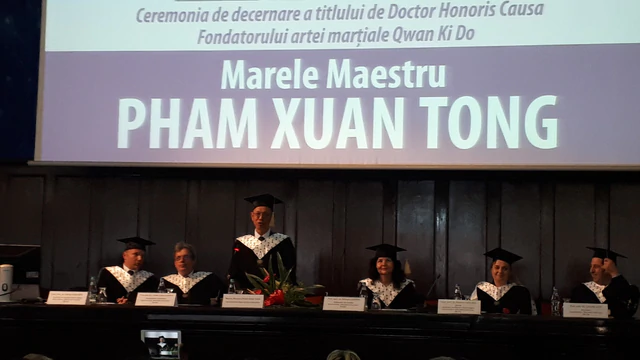
Pham Xuan Tong at the honorary doctorate ceremony at Alexandru Ioan Cuza University in Iași, Romania. Photo: A.I.C.
The international federation associated with Tong reports around 40,000 practitioners and more than 500 clubs across over 37 countries. These figures are provided by the organization itself.
From Toulon to Milan and Iași, Qwan Ki Do has established a substantial teaching network across Europe.
Qwan Ki Do is not the only Vietnamese martial art with an international presence. Vovinam, Thanh Long and Lam Son Vo Dao have also gained followings around the world.
However, Qwan Ki Do holds a distinctive position in Romania, where it has been included in both university teaching and entrance examinations.
This marks a notable chapter in the international development of Vietnamese martial arts.
Alexandru Ioan Cuza University’s 2020 admissions guidelines for its sports and athletic performance program allowed applicants to choose Qwan Ki Do as their practical sports examination.
The score accounted for 60 percent of the admissions result, while the high school graduation exam score made up the remaining 40 percent.
The assessment covered five areas: punches, blocks, kicks, defensive sequences and training forms.
Applicants were required to demonstrate proper stances, footwork and techniques on both sides of the body. Examiners assessed precision, breathing, energy and martial spirit.
In the program’s list of entrance examination disciplines that year, Qwan Ki Do was the only Vietnamese martial art named, alongside Japan’s judo and Shotokan karate.
However, this evidence alone is insufficient to conclude that it is the only Vietnamese martial art accepted in university entrance examinations across Europe.


Max: 1500 characters
There are no comments yet. Be the first to comment.