


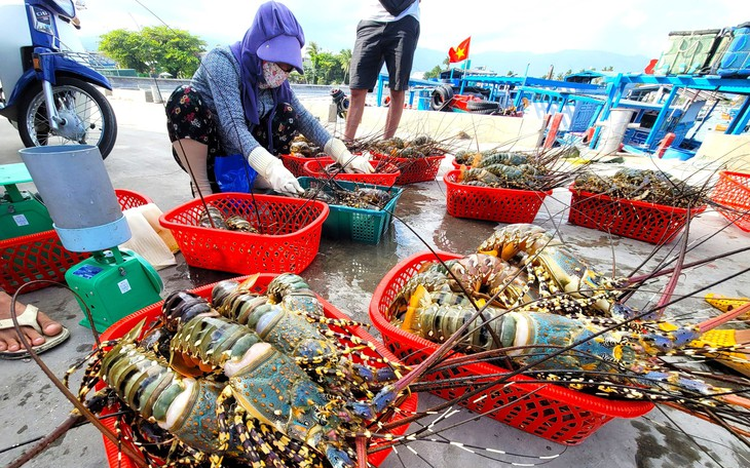
Vietnamese lobster is among the seafood products that China has increased imports of. Photo: Nguyen Hoang / Tuoi Tre
The Ministry of Agriculture and Environment said on Friday that the global situation remains complex and unpredictable in the first nine months, particularly owing to conflicts in the Middle East, disruptions to energy supplies, high oil prices, and the U.S. reciprocal tariffs.
Despite these challenges, the sector made efforts to meet and exceed most key targets, continuing to affirm its role as a 'pillar' of the Vietnamese economy.
Nearly $17 billion trade surplus
The sector's growth in the third quarter was estimated at 4.1-4.2 percent, while its public investment disbursement exceeded 60 percent.
Agricultural, forestry, and fishery exports were estimated at $56.3 billion in January-September, up nearly eight percent from the same period last year, resulting in a trade surplus of $16.9 billion, up more than seven percent year on year.
Tran Gia Long, deputy director of the Ministry of Agriculture and Environment's Department of Planning and Finance, said agricultural, forestry, and fishery exports posted strong growth in the first nine months.
China's imports expanded nearly 19 percent year on year, making it Vietnam's largest export market, capturing nearly 25 percent of the market share.
U.S. imports rose more than one percent year on year, but the market still represented nearly 20 percent of Vietnam's agricultural, forestry, and fishery exports.
Japan increased its imports by around five percent and ranked third, with a market share of more than seven percent.
"Exports of most agricultural, forestry, and fishery products increased, except for rice, coffee, and rubber, thanks to lower selling prices," Long said.
Vietnam's seafood exports neared $9.2 billion in the first nine months, up more than 12 percent year on year.
In January-August, Vietnamese shipments to China rose 34 percent, while those to Japan and the U.S. increased three percent and two percent, respectively, from the same period last year.
Fruit and vegetable exports reached nearly $7.35 billion, up nearly 20 percent from the same period in 2025.
China remained the main market for Vietnamese fruits and vegetables, accounting for 63 percent of the total export value.
Compared with the same period last year, China, the U.S., and South Korea – Vietnam's three largest fruit and vegetable export markets – all hiked their imports in the first eight months of this year, by 39 percent, 18 percent, and 10 percent, respectively.
Meanwhile, Vietnamese coffee exports climbed 15 percent in volume to 1.4 million metric tons but generated just over $6.5 billion, down more than seven percent from the same period last year.
This was due to the average export price of coffee falling nearly 20 percent in the first nine months of 2026 from a year earlier, to around $4,537 per metric ton.
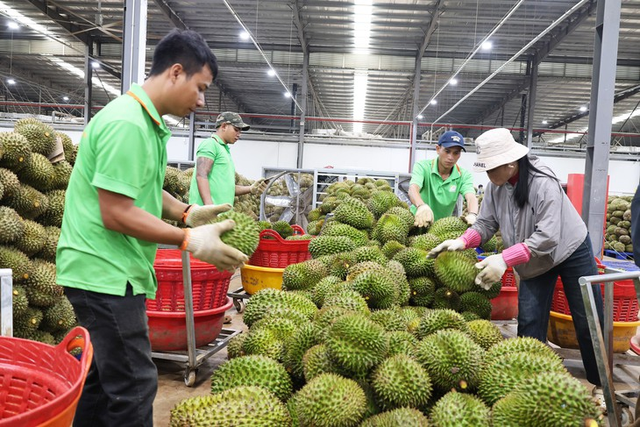
Vietnam’s fruit and vegetable exports are forecast to earn around $3.8 billion in the final three months of the year. Photo: Le Trung / Tuoi Tre
Vietnam's rice exports reached 6.4 million metric tons, down six percent, generating more than $3.1 billion, a drop of nearly 11 percent from the same period in 2025, as the average export price was only around $485 per metric ton.
Growth, export scenarios mapped out month by month
Long said that in the final three months of the year, the sector would strive to achieve an annual growth rate of four percent, in line with the new target assigned by the government to ensure the country's goal of double-digit economic growth.
"The ministry has developed adjusted growth scenarios for each sector and field on a monthly basis, with the aim of achieving fourth-quarter growth of at least 4.2 percent, thereby reaching or exceeding four percent for the full year," Long said.
"This is also a major challenge for the entire sector."
As for exports, Long said the target for agricultural, forestry, and fishery exports this year was more than $74 billion, which means the sector must achieve at least $18 billion in exports in the final three months.
To achieve this target, the ministry will focus on directing production, ensuring the availability of seeds and water supplies, and preparing disaster response scenarios to secure supplies.
It will also work closely with businesses to address difficulties and coordinate with industry associations, sectors, and companies to make the most of available potential.
The ministry estimates that fruits and vegetables will generate an additional $3.8 billion in exports in the final three months, including $1.2-1.3 billion from durians, bringing full-year durian exports to $3.8-4 billion.
Seafood shipments could generate $4 billion, while wood and forestry products are expected to bring in around $5.8 billion.
Other products such as rice, coffee, pepper, and cashew nuts are expected to generate around $7.4 billion.
"Based on our calculations and the trends in the final months of the year, markets are increasing imports in both volume and value. Therefore, we expect agricultural exports to accelerate in the final three months and reach or exceed the targets set," Long said.
- REFERENCE MORE
- REFERENCE MORE
- REFERENCE MORE
- REFERENCE MORE



Max: 1500 characters
There are no comments yet. Be the first to comment.