


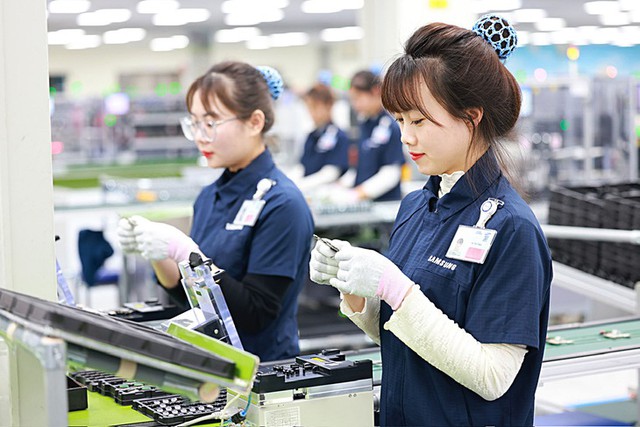
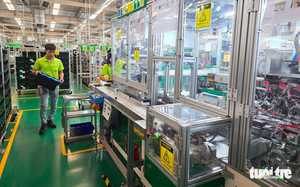
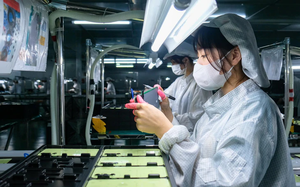
Workers at a mobile phone manufacturing plant in Bac Ninh Province. Photo: Q.P. / Tuoi Tre
The figure jumped 76.4 percent from a year earlier, according to the National Statistics Office under the Ministry of Finance.
Among the agency’s data dating back to 1988, only the full-year figure for 2008 was higher.
FDI disbursement, meanwhile, rose at a much slower pace, up 12.1 percent to more than $21 billion. Even so, it was the highest nine-month level in five years.
More than 80 percent of disbursed capital continued to flow into manufacturing and processing.
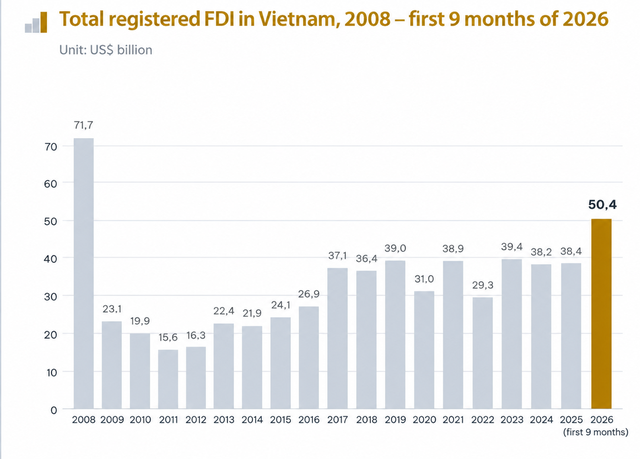
Vietnam’s FDI in the first nine months of 2026 reached its highest level since 2009. Photo: Quan Nguyen / Tuoi Tre
Fewer projects, much bigger commitments
The sharp rise in Vietnam’s newly registered FDI was driven not by a surge in project numbers, but by a small number of much larger investments.
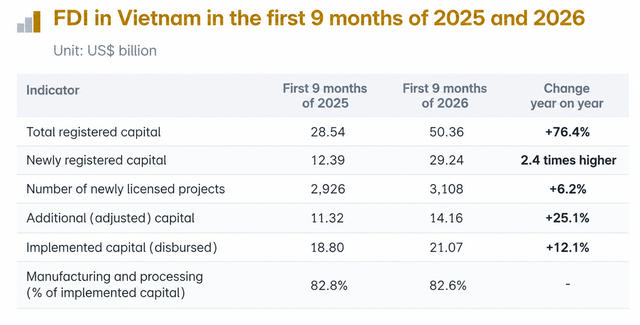
Newly registered FDI was 2.4 times higher than a year earlier. Photo: Quan Nguyen / Tuoi Tre
The number of newly licensed projects increased by just over six percent year on year, while their total registered capital was 2.4 times higher, meaning the average capital size of each new project more than doubled.
Savills Vietnam said the trend had already emerged in the first half of the year, particularly in manufacturing, where fewer new projects were accompanied by much larger investment commitments.
“We are witnessing a shift from broad-based manufacturing expansion toward deeper investment, with a stronger focus on technology, scale, and production capacity,” said John Campbell, director and head of industrial services at Savills Vietnam.
Much of the increase in new capital was concentrated in Ho Chi Minh City, Thai Nguyen Province, and Nghe An Province.
Thai Nguyen attracted only 24 new projects but recorded $8 billion in registered capital, nearly twice as much as Bac Ninh, which had 277 new projects.
Nghe An ranked sixth nationwide in total registered capital despite having only 12 new projects.
One major investment there is the Quynh Lap LNG power plant, with total capital of more than $2.2 billion. The project is being developed by a consortium involving PV Power, South Korea’s SK Innovation, and Nghe An Sugar Co.
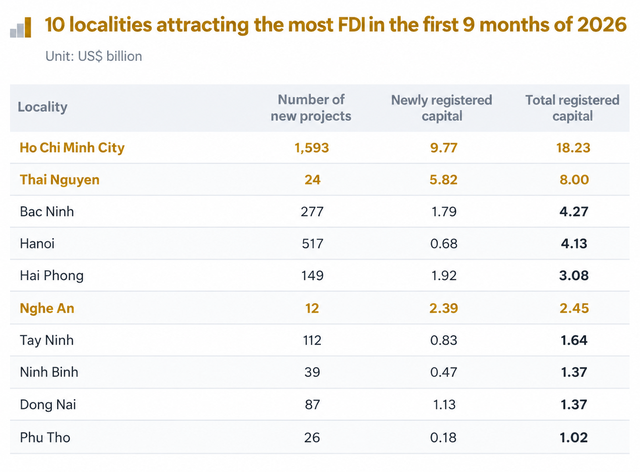
Ho Chi Minh City, Thai Nguyen, and Nghe An attracted several large-scale investment projects. Photo: Quan Nguyen / Tuoi Tre
Ho Chi Minh City led the country with more than $18 billion in registered FDI.
According to the city’s Department of Finance, two major projects attracted this year are the $4.9-billion Can Gio International Transshipment Port and the $2.1-billion AI Factory data center.
The concentration of capital in a small number of mega-projects also made the 2026 FDI trajectory more volatile.
Cumulative newly registered capital jumped from $3.5 billion to $10.2 billion in March, with Thai Nguyen and Nghe An accounting for $7.67 billion.
It rose again from $21.7 billion to $29.2 billion in September, largely driven by Ho Chi Minh City.
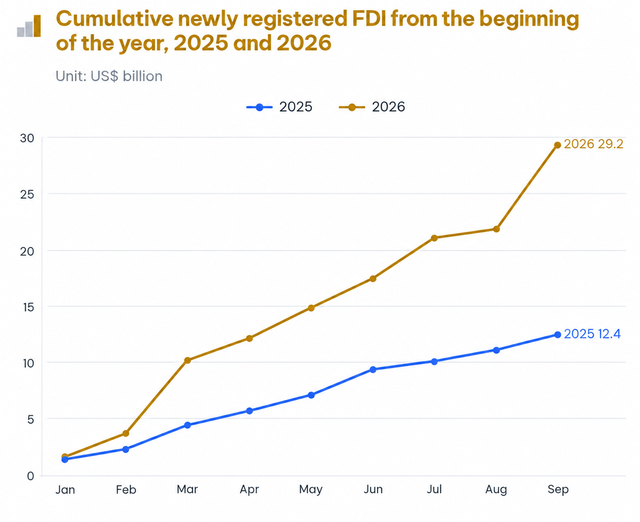
Large-scale projects made Vietnam’s 2026 FDI growth trajectory more uneven than in 2025. Photo: Quan Nguyen / Tuoi Tre
The same concentration was reflected among source markets.
Singapore and South Korea led with $12.85 billion and $9.75 billion, respectively.
Luxembourg ranked among the top four investors despite having only two new projects, ahead of China, which recorded more than 1,100.
Capital also shifted further beyond manufacturing.
Manufacturing and processing accounted for 45.8 percent of newly registered capital, down from 58.7 percent a year earlier, while transportation and warehousing rose to 17.6 percent, overtaking real estate to rank second.
Focus shifts from capital volume to investment quality
Vietnam is also seeing a gradual shift toward higher-value sectors such as semiconductors, artificial intelligence, and data centers.
Guotai Haitong Securities Vietnam said these industries are increasingly emerging as new growth pillars in place of traditional processing sectors, but require significantly higher standards of infrastructure, energy supply, and technical capability.
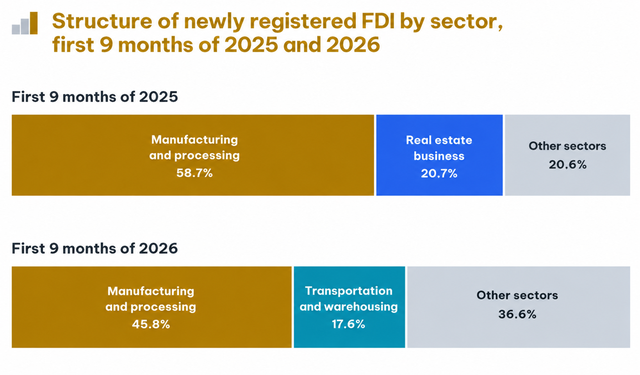
FDI flows into manufacturing and processing declined, while investment in transportation and warehousing increased. Photo: Quan Nguyen / Tuoi Tre
MB Securities, or MBS, said technology, semiconductor, AI, and particularly data center projects are becoming a new direction for FDI in Vietnam.
It added that foreign investors have moved from a “wait-and-see” approach toward greater risk diversification, with Vietnam benefiting from political stability and improving infrastructure.
Quach Ngoc Tuan, deputy director of the Ho Chi Minh City Department of Finance said the key issue was no longer simply how much FDI the city could attract, but where the capital went and what value it created.
At the national level, proposed amendments to the Law on Investment also point in that direction.
At a September 30 meeting, National Assembly Vice-Chairwoman Nguyen Thi Hong said investment incentives should be tied to investors’ commitments and actual performance, with mechanisms for evaluation and clawback.
Mirae Asset Securities said the proposed changes would gradually shift incentives away from fixed benefits toward a model linked to project performance and ties with domestic firms.
Projects that generate stronger spillover effects could receive greater incentives, while those that fail to meet commitments could lose them.
Mirae Asset said the changes could help steer FDI toward higher-quality projects rather than simply maximizing investment volumes, although the impact would take time to emerge.
One key risk remains electricity supply.
Guotai Haitong warned that demand from data centers, AI, and semiconductor manufacturing is rising rapidly while some power generation and grid projects remain behind schedule.
The bigger concern, it said, is not necessarily a nationwide power shortage, but whether electricity infrastructure can keep pace with surging demand in major industrial hubs.








Max: 1500 characters
There are no comments yet. Be the first to comment.