


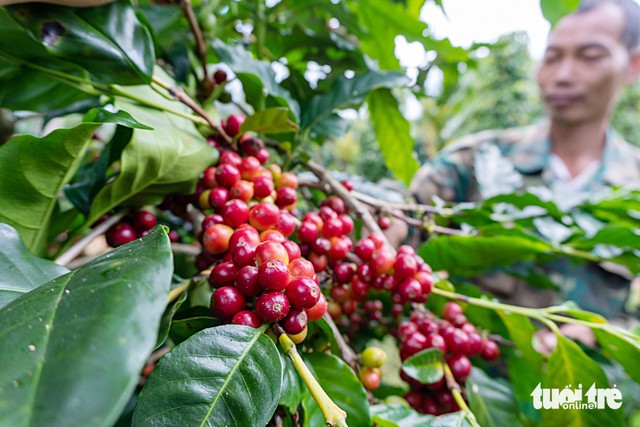
Robusta has long been regarded as inferior to Arabica. Photo: Supplied
In the 2025-26 crop year, Vietnam is estimated to produce about 29.6 million 60-kilogram bags of Robusta from nearly 630,000 hectares, with average yields of around three metric tons per hectare.
But despite its scale, Vietnamese Robusta is still often treated as a “filler” in blends – valued for body, bitterness and caffeine, but rarely for origin, processing method or producer identity.
That gap between volume and value is becoming more important as the global Robusta market changes.
Robusta demand is rising, but so is competition
Robusta has long been considered inferior to Arabica because of its stronger bitterness, heavier body and lower acidity.
That perception is gradually changing as demand grows for espresso blends, instant coffee and ready-to-drink beverages.
Robusta also has agronomic advantages: it is more drought-tolerant, more resistant to coffee leaf rust and generally more productive per hectare than Arabica.
Recent supply shocks have reinforced its importance. Drought in 2023-24 reduced coffee output in both Vietnam and Brazil, helping push London Robusta prices to multi-decade highs.
The world suddenly realized that without Robusta, the global beverage industry could grind to a halt. Yet just as demand is rising, four major challenges are tightening their grip at the same time:
First, climate change. El Niño in 2023-24 reduced yields in Vietnam’s Central Highlands, while storms and unseasonal rain during the 2025 harvest further affected cherry quality.
Brazil, meanwhile, has taken a different approach. Irrigated conilon farms in Espírito Santo and Bahia are producing 65-70 bags per hectare in some areas, with exceptional yields approaching 200 bags per hectare.
The race is no longer about who can grow the most coffee, but who can manage irrigation, synchronize flowering and achieve more uniform ripening.
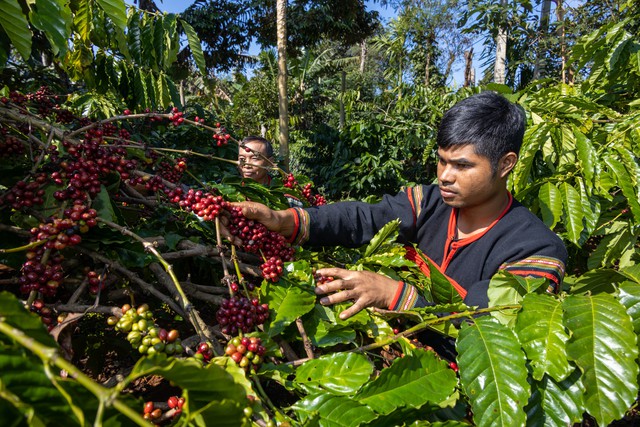
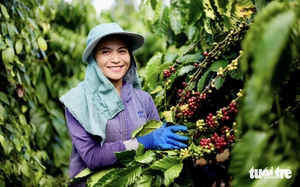
Climate change is affecting coffee-growing regions in Vietnam and around the world. Photo: Tam An / Tuoi Tre
Second, traceability requirements. Under EU Regulation 2025/2650, green and roasted coffee will be subject to the rules from December 30, 2026 for large and medium-sized companies, and from June 30, 2027 for micro and small enterprises established before December 31, 2024.
Instant coffee was only recently brought into the scope of the regulation and will not be covered until December 30, 2027.

Time to make Vietnamese Robusta coffee a global name
06/10/2026 19:50
Robusta needs trust before Vietnam builds global brand for it
05/10/2026 21:31
How can Vietnamese Robusta coffee become Fine Robusta?
04/10/2026 16:52
Vietnam has been classified as a low-risk country since May 2025, meaning due-diligence procedures are simpler, but farm-plot documentation is still required.
In practice, around 15-20 percent of the country’s coffee-growing area still faces issues related to land-use right certificates. Any lot without GPS polygon data risks being shut out of the European market, no matter how good the beans are.
Third, Brazil is rapidly closing the production gap. Brazil’s Robusta output is expected to reach a record 24.1 million bags in the 2025-26 crop year, leaving Vietnam with a much narrower lead than a decade ago.
Indonesia remains relatively stable at around 9.3-9.8 million bags, while Uganda produces about 5.8 million bags.
If Vietnam remains at an average yield of three metric tons per hectare while rivals using irrigation and new varieties exceed four tons, it could lose its position as the world’s top producer without competitors needing to expand their cultivated area.
Fourth, Fine Robusta has emerged as a distinct market segment.
At an international coffee conference in Hanoi on March 26, 2026, speakers stressed that Vietnam has no shortage of suitable ecological conditions for producing Fine Robusta.
The main bottlenecks are mixed harvesting of ripe and unripe cherries and poorly controlled processing, including drying coffee in overly thick layers.
When done properly, honey processing, raised-bed natural processing and fully washed processing can help reposition Robusta beyond its traditional association with instant coffee.
Producers that fail to move in this direction risk continuing to sell coffee by the bag rather than by origin and name.
Why Vietnamese Robusta still lacks identity
Why is Vietnamese Robusta still treated as a “filler” coffee? The problem is not the quality of the beans, but five structural bottlenecks that keep high-quality coffee from gaining stronger recognition and building distinct brands.
First, harvesting is driven by volume rather than ripeness. Green, ripe and overripe cherries often end up in the same bag. Fine Robusta requires a high proportion of fully ripe red cherries and same-day processing.
Much of Vietnam’s production still falls short of that standard, leaving international espresso drinkers with woody bitterness rather than the honey-like sweetness that careful processing can bring out.
Second, processing methods remain limited. Coffee is commonly dried as whole cherries or wet-processed on a large scale, often in thick layers and with uneven turning, while final moisture can drift outside the ideal 12-12.5 percent range, affecting quality.
Nam Ban Cooperative offers a different approach: yellow honey coffee is dried under sufficient sunlight, while red honey is protected from harsh midday sun, supported by ventilation fans and adjusted according to daily sunlight conditions. Its coffee has attracted advance orders from roasters.
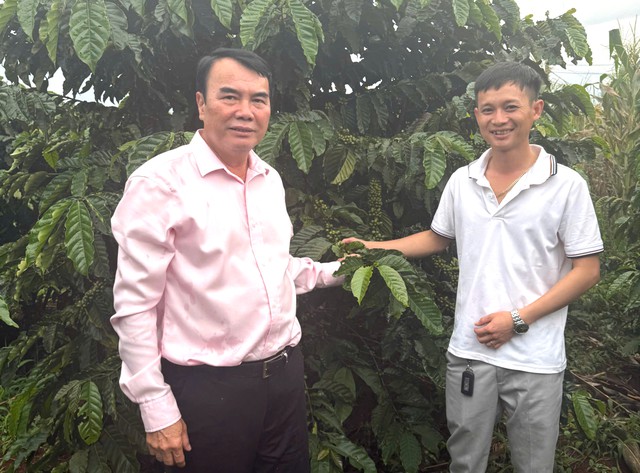
Dr. Pham S and Le Hoang Ba Vuong, director of Nam Ban Cooperative. Photo: Dr. Pham S
Third, plantations are aging and replanting has been slow.
The Central Highlands replanting program set ambitious targets from 2014, but by 2025 only about 74,500 hectares had been completed under a recent 91,000-hectare plan, still far short of the broader 200,000-hectare target.
High coffee prices in recent years have also made farmers reluctant to remove old trees, while durian, avocado and pepper have gradually taken over some of the best land.
Seed-grown plantations more than 35 years old can thin out and yield only 2.5-3 metric tons per hectare unless they are managed intensively, as in the Nam Ban model.
Fourth, the coffee often has no name on the bag.
Exports are still dominated by graded green beans blended across regions and crop years. European buyers may know “Vietnam Robusta,” but few know Nam Ban Commune, Chi Lang Hamlet or the individual producer behind a particular lot.
Without traceability, there is no story; without a story, the price ceiling often remains the London benchmark plus only a modest premium.
Fifth, EUDR documentation and plot-level data remain fragmented.
Many farms still lack GPS polygons, matched satellite imagery, land-use histories and integrated cooperative-member records.
Vietnam’s low-risk classification buys time, but it is not a permanent advantage. Competitors that complete their documentation first will secure shelf space, while latecomers may be left selling mainly to less demanding markets, remaining in a “filler” role.
7 priorities for moving beyond bulk coffee
Based on field research and production experience, seven areas stand out.
First, replant gradually with lower-growing varieties without disrupting annual output. After the 2026-27 harvest, farms should review plots more than 35 years old.
Plots yielding below 3.0 metric tons per hectare should be replanted, while those that remain productive with a healthy, closed canopy should be retained.
Replacement varieties should suit each ecological subregion, branch early, allow faster harvesting and, as seen in Nam Ban, be capable of reaching five metric tons per hectare by the third year. Replanting should be staggered within each household so farmers can maintain production every year. By 2027-28, areas requiring renewal should be fully identified and addressed.
Second, purchasing contracts should shift from mixed-picked cherries to fully ripe red cherries. Floor prices should be tied to the proportion of ripe fruit, with penalties for green cherries and bonuses for uniform lots.
This is one of the least expensive changes but could have the greatest impact on Fine Robusta quality. Without it, investments in dryers and certifications further down the chain would merely mask a problem that begins at the farm.
Third, honey and raised-bed natural processing should be standardized as regional practices rather than remain the know-how of a single cooperative.
Cherries should be pulped on the day of harvest, dried in thin layers, turned frequently during the first days and brought down to 12-12.5 percent moisture. Yellow and red honey should be handled differently depending on sunlight conditions.
Nam Ban Cooperative has already sold its coffee at prices around 30 percent higher than the local average and received advance orders from buyers and roasters.
Scaling up the model would require drying yards, raised beds, shade structures for the midday sun, ventilation fans and detailed processing logs.
Fourth, controlled organic farming should be combined with climate-smart agriculture. Compost made from coffee husks, manure, Trichoderma, ground cover, shade trees and biological crop-protection products are already being used in practice, with some older plantations still yielding four metric tons per hectare.
The missing piece is better water management: efficient irrigation, sprinkler irrigation timed to flower-bud development, and an end to wasteful flood irrigation.
Brazil’s advantage comes from water management and plant varieties, not from basalt soil. Shade and organic matter that help retain moisture are part of the Central Highlands’ response to drought years such as 2024.
Fifth, plot-level data should come before talk of artificial intelligence.
Big data, IoT, AI, blockchain and drones only become meaningful when each farm plot has its own identification code, GPS polygon, satellite imagery and cooperative-member records. That data should allow producing regions to know where each lot is being sold, giving the coffee a verifiable identity rather than leaving it anonymous.
Sixth, EUDR documentation should be completed down to individual households and treated as a market passport rather than a box-ticking exercise.
Records should include cooperative-member information, GPS polygons, land-use history and checks against current forest-cover data. The newly expanded Lam Dong Province has set a target for 70 percent of its coffee-growing area to receive production-area codes by 2030, with 100 percent of the area complying with EUDR requirements.
Seventh, only after the first six measures are firmly in place should farms and localities, depending on their conditions, expand into agritourism and on-site processing. Serving visitors honey-processed coffee at the farm only has real value when the cup can be traced back to a specific plot, household and drying date.
At that point, the area is no longer just a tourist destination. It becomes a model ESG showcase for Vietnamese Robusta, where organic farming, traceability, branded processing and local income all reinforce the product’s identity.
A national coffee brand is not built through conference statements alone. It is built repeatedly, lot by lot, through products with a clear origin, story and value.
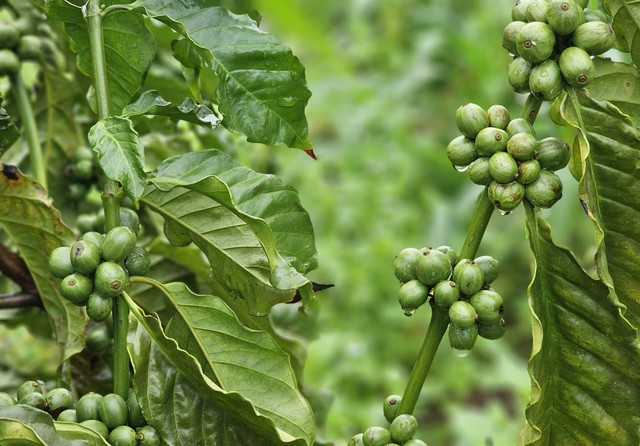
Vietnam does not lack Robusta-growing land; what it lacks is recognition by name. Photo: Supplied
Vietnam already leads the world in Robusta output. The next challenge is turning scale into identity and higher value.
As Brazil competes on productivity, the EU tightens traceability rules and specialty roasters pay more for quality and origin, Vietnam must strengthen cultivation, processing and farm-level traceability.
That is how Vietnamese Robusta can move from being a “filler” to a coffee recognized by name.








Max: 1500 characters
There are no comments yet. Be the first to comment.